








A Lagoon catamaran sinks in the Indian Ocean – even though a known weak point had already been retrofitted. The case raises questions about the safety of escape hatches. Older catamarans from other major manufacturers are also potentially affected. What owners should urgently check now.
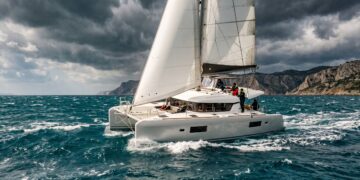
In the middle of the night, the water alarm sounds. James “Ted” Rutledge, 70, Canadian and sailing solo across the Indian Ocean, grabs a flashlight. In the starboard hull of his Lagoon 42, the floorboards are already lifting. Seawater is pouring into the boat through an opening about half a meter wide. Apparently, the glazing of an escape hatch has detached.
Roughly 1,000 kilometers east-southeast of Christmas Island, far away from any rapid assistance, Rutledge realizes within minutes that he can no longer save his catamaran.
In an interview with the Australian broadcaster ABC, published on September 30, 2026, he later describes the disastrous dynamics: the more water rushed in, the deeper the bottom edge of the opening sank below the water’s surface – and the faster the boat took on further water. His succinct conclusion: “I knew it was over. I had to abandon ship.” That is how the Australian broadcaster ABC News quoted him in its report on September 30, 2026.
The life raft is already unreachable. Rutledge therefore attempts to free the dinghy hanging between the hulls. In the process, his hand gets trapped. It takes a wave to free it again. Finally, he manages to escape into the dinghy. His most important “lifeline” at this moment is an agreement with his family: he reports his position back to Canada on a regular basis. When the messages stop coming, his brother raises the alarm.
The Australian Maritime Safety Authority (AMSA) launches a search. A search aircraft spots the partially sunken catamaran and the sailor in his dinghy. A life raft, communication equipment, and emergency supplies are dropped from the air. A helicopter from the Royal Australian Navy ship HMAS Supply finally rescues Rutledge from his plight. After around 15 hours at sea, the Canadian is safe. His catamaran is not.
Of all things, the escape hatch
However, the actual safety issue does not lie solely in the sinking of the boat. It lies in a design intended to save lives in an emergency – but which, under unfavorable circumstances, can itself become a danger, as has now occurred.
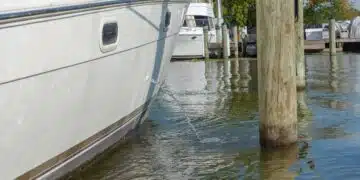
Sailing catamarans feature dedicated escape hatches in their hulls. These are designed to allow a trapped crew to escape in the event of a capsize, when the vessel is floating upside down and normal exits are no longer accessible. Often, these hatches are located on the inner sides of both hulls, relatively close to the waterline.
This means: As long as the catamaran is floating upright, the hatch must remain reliably watertight against spray, wave impact, and at times considerable water pressure.
With the fixed GOIOT hatches affected here, a sheet of safety glass is bonded to an aluminum frame. This frame, in turn, is screwed to the hull. If the bond between the glazing and the frame fails, a large opening can emerge through which water enters unhindered.
Lagoon itself confirms that this is not merely a theoretical danger. In its official recall notice dated June 17, 2026, the shipyard states that the measure, underway since 2019, is designed to retain glazing in the frame should detachment occur and prevent or reduce the risk of water ingress.
One recall, four major catamaran manufacturers
The problem has been known since at least 2019. On February 7, 2020, the Nautitech shipyard published an announcement regarding the recall campaign by French equipment manufacturer GOIOT Systems. Four major catamaran builders were explicitly named: Lagoon, Fountaine Pajot, Bali, and Nautitech.
According to Nautitech, the recall concerned GOIOT escape hatches delivered before September 2018. For its own fleet, the yard specifically identified the Nautitech 542, 40 Open, and 46 Open/Fly models built between August 2014 and 2018.
Lagoon specifies in its update from June 2026 that additional retaining brackets must be installed on certain yachts built between 2007 and 2019. These are intended to prevent a pane that has already detached from coming out of the frame entirely.
A German Lagoon dealer lists models including the Lagoon 380, 39, 40, 400, 420, 440, 450, 42, 50, 52, 560, 620, and 630 on its information page, along with several variants. Crucial, however, is not just the model designation, but also which specific hatch is actually fitted on the individual boat.
This confirms that the problem is by no means limited to a single Lagoon model (though naming four shipyards does not mean that every catamaran from these builders is inherently defective; specific model lines and equipment series are affected).
Retrofitted – and yet sunk
Particularly critical is James Rutledge’s statement that his Lagoon 42 had already been retrofitted following the recall. He had the work carried out in Panama. In his interview with ABC, Rutledge stressed that on such an expensive boat, he had trusted that the components used were reliable. He criticized the quality of the parts.
What remains unresolved so far: Was the safety kit actually installed correctly? Was it fully present and functional at the time of the accident? Did the adhesive bond fail once more? Or was the hatch possibly already too old or otherwise damaged? These answers are critical. After all, documented retrofitting does not prove that the safety mechanism itself failed.
The specialist magazine YACHT also pointed out explicitly in its coverage on October 12, 2026, that the age and condition of the damaged hatch, as well as the exact cause of the failure, remain unclear.
Also noteworthy is an earlier statement from the yard. On its support page, Lagoon explained that in April 2019, it had learned of isolated cases in which the glazing had detached from the aluminum frame and water had entered. The vulnerability had therefore been known for around seven years prior to the accident.
Not an isolated incident
Back in January 2023, YACHT reported on the sinking of a Lagoon 39 in the Caribbean. The catamaran had been built in 2013. According to evidence available at the time, an unreplaced escape hatch had been forced out of its frame by wave pressure. This case was also linked to the GOIOT recall.
Added to this is another Lagoon 42 catamaran that suffered an accident in the Caribbean in 2025, which YACHT also covered. Several severe water ingress incidents involving escape hatches are therefore publicly documented. However, a reliable statistical statement on the frequency of such damage or the failure rate of retrofitted hatches cannot be deduced from this.
Nevertheless, these cases demonstrate just how serious the consequences can be. Unlike a seacock that develops a slow leak, a completely lost hatch pane can trigger massive water ingress in no time at all. Once the opening is below the waterline, even high-capacity bilge pumps can quickly become overwhelmed.
A new recommendation raises questions: replacement after ten years
A major focus of the current safety debate now centers on the age of the hatches. Lagoon writes unmistakably in its release of June 17, 2026, that the affected GOIOT escape hatches must be replaced after ten years – regardless of whether the supplementary retention system has been installed.
The shipyard justifies this with the aging of materials and adhesives caused by UV radiation, temperature fluctuations, humidity, and saltwater. The safety kit does not extend the lifespan of the hatch.
Supplier GOIOT phrases the rule somewhat differently. In its safety notice dated April 25, 2025 (since updated), the company states an estimated service life of ten years under “normal operating conditions.” An automatic replacement thereafter is not strictly mandatory, provided installation, maintenance, and at least annual inspections comply with the manufacturer’s recommendations.
However, in the event of damage, abnormal wear, or doubts about watertightness, GOIOT explicitly advises against setting sail until the issue has been resolved.
The difference is significant for owners: while GOIOT permits condition-based continued use beyond ten years under certain conditions, Lagoon demands replacement upon expiration of this timeframe for hatches covered by its notice.
Affected Lagoon owners should therefore follow the explicit requirements of their shipyard in case of doubt. For other catamaran brands, current manufacturer guidelines must be obtained directly.
SeaHelp service: What catamaran owners should check right now
1. First, identify the hatch
Check whether a GOIOT escape hatch is installed. Document the model, year of manufacture, Hull Identification Number (HIN), and if possible the markings or part number of the hatch, and have them confirmed by the shipyard.
2. Verify recall and retrofit history
Never assume a previous owner carried out the work. Check workshop invoices, retrofit certificates, and installation manuals. If documentation is missing, contact the shipyard.
3. Have bonding and watertightness inspected
Warning signs include cracks, delamination, unusual gaps, water traces, corrosion, and visible alterations to sealants or adhesives. A visual inspection, however, is no substitute for a professional evaluation.
4. Factor in age
For an affected Lagoon hatch, schedule replacement after ten years. For other manufacturers, inquire directly about their current replacement intervals.
5. Avoid improvised repairs
Safety-critical glazing and retaining assemblies should only be replaced or retrofitted in accordance with manufacturer specifications. Permanently sealing or removing an escape hatch unauthorizedly can impair escape routes in a capsize scenario and raise regulatory compliance issues.
6. Be prepared for emergencies at sea
The life raft, EPIRB, communications gear, and distress signals must be immediately accessible even during severe flooding. In addition, automatic bilge pumps, early-warning water alarms in both hulls, and a clear emergency plan are strongly recommended. Following the latest disaster, AMSA especially highlights the value of reliable communication links and a shoreside contact person who sounds the alarm if check-ins fail.
(Note: Should a technical investigation or a formal statement from the shipyard be published, the current assessment of the accident’s cause may change. We will report promptly on this in an update).