SeaHelp News

Technology

MAN's ME-LGIM engine: dual-fuel propulsion system for methanol and conventional fuel, based on the proven ME series, offers CO2-neutral ship operation and high efficiency.© MAN Energy Solutions

According to a recently published report by the Maritime Cluster Northern Germany (MCN), methanol is well on its way to establishing itself as one of the most important fuel options alongside LNG and ammonia, as well as bio-based fuels such as FAME, due to its high potential in the decarbonization of shipping and environmental protection. SeaHelp supports more environmentally friendly...

Read more
Motorboat with 48V Aries-i50 electric drive from Molabo

The small company Molabo from Ottobrunn has introduced nothing less than a paradigm shift in boat drives with the innovative electric motor Aries: for the first time, it is now possible to use a safe and reliable 48-volt low-voltage with safe-to-touch technology instead of the previously used 400-volt high-voltage for motorboating. Now, the award-winning 48-volt technology is also available as...

Read more
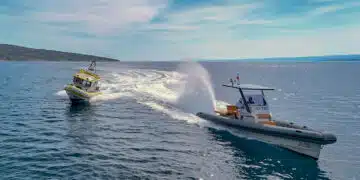
Test drive eBoot eD 32 c-ultra from eD-Tec in Croatia

eD-Tec (Electric Driven Technology) is the name of a young start-up that develops electric drives for motorboats. A year ago, the company tested the first boat equipped with such a system. Now the Munich-based inventors are launching their second product: a new 9.5 metre-long high-performance rigid inflatable boat called the eD 32 c-ultra, which will be available with cruising and...

Read more
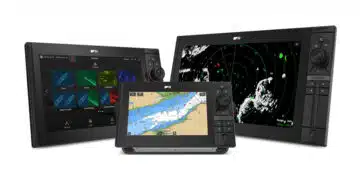
Raymarine Axiom Pro2 Serie

Chart plotters, i.e. marine navigation devices that show an electronic chart on a display, were originally mainly used in large-scale shipping. They are now integrated into electronic information systems (ECDIS), which cover the entire ship management. Chart plotters have found their way into the recreational boating sector due to the sharp drop in prices in the 1990s and are now...

Read more
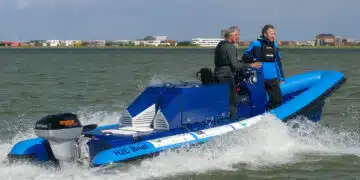
E-Boot mit eD-QDrive 1 von eD-TEC Germany and der Ladesäule

eD-TEC (Electric Driven Technology) is the name of a young startup from Munich that develops electric drives for motorboats. In May, the company tested the first boat equipped with a corresponding system. SeaHelp secured the test runs in Croatia on the island of Krk off the Punat marina. The future on the water is electric - of this Michael Jost...

Read more
MAN Smart HYBRID Experience with V12

A future-oriented drive solution for yachts was recently presented by engine manufacturer MAN: The so-called Smart Hybrid Experience is intended to offer the advantages of a conventional drive and expand them with the modern possibilities of electric motors and batteries. In addition to increasing efficiency and range, noise emissions should thus be reduced to zero; moreover, the battery-electric operation of...

Read more
UKW-Funk (Seefunk) auf Yacht & Boot - UKW-Funkgerät an Bord

VHF radio (marine radio) has been one of the most important means of communication on yachts for many years and will not be replaced by cell phones in the foreseeable future. Especially in maritime emergencies or when registering in marinas, the radio is clearly superior because automatically all ships in the vicinity can listen in and possibly give quick assistance....

Read more
\r\n\r\n \r\n\r\n \r\n\r\n\"eD-TEC<\/a>\r\n
\r\nJOST Group GmbH & Co KG<\/strong>\r\nZeppelin Street 71-73\r\n81669 Munich | Germany\r\nTel: +49 (0) 89 360 368 20<\/a>\r\nEmail: info@jost.de<\/a>\r\nWeb: www.jost.de<\/a>\r\n\r\neD-TEC Germany<\/strong>\r\nZeppelin Street 71-73\r\n81669 Munich | Germany\r\nEmail: future@ed-tec.de<\/a>\r\nWeb: www.ed-tec.de<\/a><\/div>","post_title":"New electric drive from eD-TEC: <\/span><\/span>The future on the water is electric","post_excerpt":"","post_status":"publish","comment_status":"open","ping_status":"closed","post_password":"","post_name":"e-boat-drive-ed-tec-ed-qdrive","to_ping":"","pinged":"","post_modified":"2023-05-31 10:13:26","post_modified_gmt":"2023-05-31 08:13:26","post_content_filtered":"","post_parent":0,"guid":"https:\/\/www.sea-help.eu\/news-general\/e-boat-drive-ed-tec-ed-qdrive\/","menu_order":0,"post_type":"post","post_mime_type":"","comment_count":"0","filter":"raw"},{"ID":48491,"post_author":"13","post_date":"2023-05-16 09:09:36","post_date_gmt":"2023-05-16 07:09:36","post_content":"VHF radio (marine radio)<\/a> has been one of the most important communication means on yachts for many years. This will continue to be the case in the future, because the radio is clearly superior to mobile radio, especially in maritime emergencies or when logging on at marinas. However, certain channels are to be used exclusively for VDES in the future. SeaHelp spoke about the upcoming changes with yacht electronics specialist Werner Ober.\r\n\r\nThrough the 2015 and 2019 World Radiocommunication Conferences of the International Telecommunication Union (ITU), it was determined that the conditions should be created to introduce a new digital data exchange system on VHF channels (VHF Data Exchange System, or VDES for short).\r\n\r\n\"It was decided that certain VHF channels of Annex 18 of the Radio Regulations should be used exclusively for VDES in the future\"<\/em>, says yacht electronics specialist Werner Ober, who runs a company of the same name in Lustenau.\r\n

The new digital data exchange system VDES is on the rise<\/h2>\r\nThis would affect channels 24, 84, 25, 85, 26, 86, 27 and 28; important to know: these channels may then no longer be used for analog voice transmission. \"Germany, Holland and Belgium have already adopted the directive and have set a deadline of January 1, 2024 for vessels flying the relevant flag to make the switch. At the European level, the necessary conversions should already be completed by January 1, 2023\"<\/em>, says Werner Ober.\r\n\r\nWork on VDES has been going on \"for a long time,\" said Ernst Cerny of the Austrian telecommunications authority, but in Austria \"nothing will probably change here for a while longer.\" However, it is \"particularly in Germany, Holland and Belgium to follow the development closely\", because: some channels would be converted to digital in the ATIS range, and also the frequencies of RX & TX would be moved.\r\n

Sport skippers should inform themselves carefully, because certain channels should soon no longer be able to be used for analog voice transmissions<\/h2>\r\nAs a result, channels 25, 25, 26 84 85 & 86 should then no longer be available on the device when ATIS is in operation, says Werner Ober. These channels are then not likely to be used in the affected countries (which have already implemented VDES), even in normal operation, the yacht electronics professional said.\r\n\r\nIn addition, channels 2019, 2020, 2078 and 2078 would only be allowed to be used for reception in all ATIS modes; transmitting would then only be allowed with a private license. In addition, channels 27 and 28 would have to be completely removed from the international frequency band in all ATIS modes. The same would apply to channel 96 (private channel in Belgium).\r\n

The timing of when individual countries will implement VDES is not yet known<\/h2>\r\nAs additional voice channels would be added, channels 1027 and 1028, Werner Ober said. Channel 31 (Holland) would be renamed \"Marina\" and would now also be the new Belgian private channel. Its use as a private channel in Holland also remains unchanged with the new names, he adds.\r\n\r\nThe yacht electronics specialist advises all sports skippers, especially if they are traveling Holland, Germany and Belgium, to find out in advance exactly what the current status of the implementation of the regulations is in the region concerned.\r\n\r\nThe exact point in time when the individual countries will implement VDES is not known, says Werner Ober. Currently, \"various information\" is circulating about this, he added.\r\n

Information and advice:<\/h2>\r\nSpecialist for consulting and installation of yacht electronics is the company WERNER OBER GmbH & Co KG - Yachtelektronik.\r\n\r\n\"\"<\/a>\r\n\r\n \r\n\r\nWerner Ober GmbH & Co KG<\/strong>\r\nYacht electronics\r\nReichsstrasse 38\r\n6890 Lustenau | Austria\r\n\r\nTel: +43 (0)5577 824 19<\/a>\r\nEmail: werner.ober@yachtelektronik.at<\/a>\r\nWeb: www.yachtelektronik.at<\/a>","post_title":"UKW radio (marine radio) on yachts: <\/span><\/span>New digital data exchange system VDES is coming","post_excerpt":"","post_status":"publish","comment_status":"open","ping_status":"closed","post_password":"","post_name":"ukw-radio-sea-vdes","to_ping":"","pinged":"","post_modified":"2023-05-16 09:09:36","post_modified_gmt":"2023-05-16 07:09:36","post_content_filtered":"","post_parent":0,"guid":"https:\/\/www.sea-help.eu\/news-general\/ukw-radio-sea-vdes\/","menu_order":0,"post_type":"post","post_mime_type":"","comment_count":"0","filter":"raw"},{"ID":46442,"post_author":"11","post_date":"2023-01-02 08:35:47","post_date_gmt":"2023-01-02 07:35:47","post_content":"A future-oriented drive solution for yachts was recently presented by engine manufacturer MAN: The so-called Smart Hybrid Experience is intended to offer the advantages of a conventional drive and expand them with the modern possibilities of electric motors and batteries. In addition to increasing efficiency and range, noise emissions should thus be reduced to zero; moreover, the battery-electric operation of the equipment should also be able to secure access to future water protection areas (Marine Protected Areas)<\/strong>.\r\n\r\nRecently we reported here that the Balearic regional government passed a law that regulates how Mallorca and neighboring islands will achieve the goals in the fight against climate change. In order to also bring the economy on Mallorca and the sister islands to a \"green line\", only electric yachts are to be allowed to be rented out on Mallorca and the neighboring islands by 2030.\r\n\r\nSo it provides in any case currently a \"draft for the amendment of the regional climate change law\", which was prepared by the Balearic Energy Ministry under Juan Pedro Yllanes, as the Mallorca newspaper reported on 26.10.2022. According to the law, boat rental companies are to gradually upgrade their fleets until they no longer produce emissions in eight years. This has led to an \"outcry in the industry\", yacht rental companies are \"angry\" and would even speak of the \"end for their industry\", headlined the Mallorca Newspaper<\/a> (see our message \"draft law bans internal combustion charter boats from 2030<\/a>\" dated 02\/11\/2022).\r\n

The Smart Hybrid Experience program is designed to offer the benefits of conventional propulsion and add modern capabilities<\/h2>\r\nA forward-thinking powertrain solution that shouldn't upset anyone and could even give the industry a new lease on life was recently unveiled by engine manufacturer MAN: The so-called Smart Hybrid Experience program is designed to offer the advantages of a conventional drive and expand them with the modern possibilities of electric motors and batteries.\r\n\r\nEffect: In addition to increasing efficiency and range, it should be possible to reduce noise emissions to zero; moreover, the battery-electric operation of the systems should also be able to secure access to future water protection areas (Marine Protected Areas).\r\n

The modular system is geared to the customer's needs and can be flexibly combined<\/h2>\r\nThe modular system is to be \"individually oriented to the customer's needs\" and will be \"specifically configured to that end,\" MAN says; the \"flexible combination of conventional marine engines as well as electric engines with batteries and on-board gensets\" offers \"countless possibilities for degrees of hybridization in recreational boating and the commercial sector.\"\r\n\r\nBased on the desired operating modes, the MAN hybrid system is said to be able to focus the driving profiles on performance, comfort or efficiency. Many individualizations are possible, says Dr. Matthias Schreiber, Head of MAN Engines, for example; as a system supplier, the engine manufacturer accompanies its customers \"throughout the entire process chain - from the planning and concept phase through development to the technical implementation of the complex drive components as well as batteries and power electronics.\"\r\n

There are different operating modes: battery and diesel-electric, cross-over, hotel and boost<\/h2>\r\nShipyards received a complete system from a single source. For service and maintenance, MAN Engines' well-developed network of service stations in all major ports worldwide is also to be available.\r\n\r\nFor the configuration of the driving profiles, MAN Engines resorts to different operating modes, ranging from battery and diesel-electric modes to cross-over, hotel and boost modes. These drive configurations are said to make it possible to efficiently implement numerous driving and operating profiles.\r\n\r\n \r\n\r\n\"Zero-emission<\/a> Zero-emission mode of the MAN Smart HYBRID Experience\u00a9 MAN<\/a><\/span>[\/caption]\r\n\r\n \r\n

Emissions should be able to be reduced to zero with the new system; when anchoring, there is \"clean\" and quiet electricity<\/h2>\r\nIn particular, this is to include the possibility of a particularly economical driving style, combined with an increase in range, but also the retrieval of additional power as a power boost, which is to be available to the customer as an option. The new hybrid system should also make it possible to reduce emissions to zero; it should also be possible to ensure a completely emission-free power supply when anchoring.\r\n\r\nSo they already exist, the sensible alternatives, so there can be no talk of an \"end of the industry\", as feared by the boat rental companies on the Balearic Islands. Nevertheless, what has already been established on the road will - consequently - now probably also become reality on the water in the foreseeable future. In its new Climate Plan \"Fit for 55\"<\/a>, the EU Commission calls for the year 2035 to completely reduce annual CO2 emissions from new motor vehicles to zero. Translated with www.DeepL.com\/Translator (free version)","post_title":"Instead of combustion engine bans: <\/span><\/span>New marine hybrid propulsion systems are low-emission, efficient and offer performance and comfort","post_excerpt":"","post_status":"publish","comment_status":"open","ping_status":"closed","post_password":"","post_name":"man-smart-hybrid-drive-systems-marine","to_ping":"","pinged":"","post_modified":"2023-01-02 08:35:47","post_modified_gmt":"2023-01-02 07:35:47","post_content_filtered":"","post_parent":0,"guid":"https:\/\/www.sea-help.eu\/news-general\/man-smart-hybrid-drive-systems-marine\/","menu_order":0,"post_type":"post","post_mime_type":"","comment_count":"0","filter":"raw"},{"ID":41553,"post_author":"12","post_date":"2022-05-29 14:17:51","post_date_gmt":"2022-05-29 12:17:51","post_content":"VHF radio (marine radio) has been one of the most important means of communication on yachts for many years and will not be replaced by cell phones in the foreseeable future. Especially in maritime emergencies or when registering in marinas, the radio is clearly superior because automatically all ships in the vicinity can listen in and possibly give quick assistance.\r\n\r\nIn order for the VHF radio on the ship to work well and provide the maximum range, some points are very important and must be taken into account.\r\n\r\n \r\n\r\n\"Ray73<\/a> Ray73 from Raymarine with integrated VHF, AIS receiver and megaphone functions.\u00a9 Raymarine<\/a><\/span>[\/caption]\r\n\r\n \r\n

Antenna and cable<\/h2>\r\nA VHF radio needs a good antenna and an equally suitable antenna cable. Often a RG58U cable is used, which works well up to a cable length of 6m but brings a strong loss of transmission power at greater lengths. Therefore, it is necessary to check the cable length of the antenna cable before installation in order to choose a suitable cable.\r\n\r\n \r\n\r\n\r\n\r\n\r\n\r\n\r\n\r\n\r\n
Cable designation<\/th>\r\nDiameter<\/th>\r\nMax. Length with low power loss<\/th>\r\n<\/tr>\r\n<\/thead>\r\n
RG58U 50 Ohm<\/td>\r\n5 mm<\/td>\r\n6 m<\/td>\r\n<\/tr>\r\n
CO100 50 Ohm<\/td>\r\n6 mm<\/td>\r\n30 m<\/td>\r\n<\/tr>\r\n
Aircell 7 50 Ohm<\/td>\r\n7 mm<\/td>\r\n30 m<\/td>\r\n<\/tr>\r\n
RG213U 50 Ohm<\/td>\r\n13 mm<\/td>\r\n40 m<\/td>\r\n<\/tr>\r\n<\/tbody>\r\n<\/table>\r\n \r\n\r\nThe antennas are available in different lengths. The longer the antenna, the better the transmission performance when the antenna is vertical. Shorter antennas are often used on sailing yachts, because this allows the radiation to be targeted parallel to the horizon even when the antenna is tilted. Therefore, even with long antennas it is important that they are mounted vertically and not tilted backwards, if maximum range is desired.\r\n\r\n\"Short<\/a> The emission for a short antenna is circular, so heeling does not matter here.
Of course, the emission occurs further than the area drawn in yellow. This is only to clarify the function so chosen!<\/small>\u00a9 Werner Ober GmbH & Co KG Stock<\/span>[\/caption]\r\n\r\n
\"Long<\/a> The transmission at a long antenna is elyptical, therefore the heeling has a negative effect here. The signal goes into the water or the sky.
Naturally, the transmission takes place further than in the yellow drawn area. This is only to clarify the function so chosen!<\/small>\u00a9 Werner Ober GmbH & Co KG Stock<\/span>[\/caption]\r\n\r\n \r\n\r\nAn equally important point is the correct mounting of the antenna connectors. The PL259 connector is the most common connector for radio cabling. Here it is particularly important that there is good contact with the cable shield and that the hot lead (inner lead of the coaxial cable) is soldered to the connector (see blue arrow).\r\n\r\n
\"VHF<\/a>\r\n\r\n \r\n\r\nIf an AIS with an antenna splitter is also mounted on the vessel, must<\/strong> use a wideband VHF antenna (20MHz) so that both the radio and the AIS can work well. With a standard VHF antenna, a standing wave error may be displayed on the AIS and the AIS transmission may not occur.\r\n

Range of VHF radios<\/h2>\r\n.\r\nThe theoretical range of a VHF radio can be calculated very easily. For this purpose, the following formula applies:\r\n

distance (nm)<\/strong> = \u221a(1.42 x antenna height in feet).\r\ne.g. if an antenna is on a 30 foot mast (about 9m):<\/em><\/p>\r\n\r\n

\u221a(1.42 x 30) = 6.5 nautical miles (approximately)<\/strong><\/h3>\r\n

Approval<\/h2>\r\nAny radio equipment (like all transmitting equipment as well as radar, AIS, SART...) must be approved in that country under whose flag the vessel is registered. In addition to the Declaration-of-Conformity, the notification (this is done by the manufacturer\/importer) is required in the corresponding country of registration. During registration, the MMSI (M<\/strong>obil M<\/strong>aritime S<\/strong>hip I<\/strong>dentity) is assigned, which must be programmed into the radio. For equipment that is also used on inland waterways, the telecommunications authority also issues the ATIS number.\r\n\r\nAs of November 2018, manufacturers are only allowed to sell marine radios with the ability to connect an external GPS antenna. Even if the radio has a built-in GPS, this connection must be available. Devices without DSC (Digital-Selective-Calling = this is the new distress call facility where the GPS position and the MMSI number of the vessel is always sent along), will no longer be allowed.\r\n\r\nAlso note that the Declaration-of-Conformity is required for registration and it must not be older than 5 years. If you buy a used boat and there is already a radio with MMSI number installed, must<\/strong> delete this number. You can not do this yourself and can only be done by a corresponding service station of the radio manufacturer. (for Raymarine e.g. company Werner Ober GmbH & Co KG - Yachtelektronik, contact see below).\r\n\r\nVHF handheld radios can be approved on Austrian-flagged vessels only in addition to a fixed installed radio system and must of course also be registered.\r\n

Features and options<\/h2>\r\nEvery current VHF radio must have the DSC function described above. In case of distress at sea, the corresponding button (this is red and secured behind a flap) is pressed. Then predefined distress messages are shown on the display and the applicable one is selected, and the distress call is confirmed.\u00a0The unit will then transmit the distress message with the current position, date and time until a coastal radio station responds. It then switches to a working channel to coordinate assistance. During this time, there is no need to continuously radio mayday-mayday, but work can continue on the problem resolution.\r\n\r\nThere are also radios available with multi-station function or in a black box solution (the transceiver is installed hidden and \"only\" the handsets with display are visible).\r\n\r\nWith these devices several radio stations can be connected to one device, e.g. to be able to communicate from the flybridge as well as from the main helm station.\r\n\r\nThese second stations can be solved with cable or also wirelessly. With many devices there is also an intercom function (intercom) between the stations.\r\n\r\n \r\n\r\n\"Ray90<\/a> Ray90 from Raymarine with black-box design and the ability to connect wired and wireless RayMic handheld.\u00a9 Raymarine<\/a><\/span>[\/caption]\r\n\r\n \r\n\r\nWith the highest quality radios, a pressure chamber horn (Loudhailer) with intercom function can also be connected. This allows the radio to easily talk to the crew member at the forecastle or the marina worker. These radios also have the ability to use the pressure chamber horn as a foghorn or siren.\r\n\r\nCombined radios with built-in AIS receiver<\/a> are also available. Radio systems with built-in AIS transponder are hardly available and very vulnerable, because the transmitting power must be switched continuously between AIS transmission and VHF transmission. This is VERY hard on the power amplifiers and reduces the lifetime.\r\n\r\nThe formerly used function to connect to the public telephone network from a coastal radio station is hardly used anymore and has been largely replaced by cell phones. Only in areas with poor GSM network coverage is this function still occasionally used.\r\n\r\nIn conclusion, VHF marine radio will remain in use as a means of communication internationally and near the coast for a long time to come and is also mandatory in almost all equipment lists.\r\n\r\n \r\n

Information and advice<\/h2>\r\nSpecialist for consulting and installation of yacht electronics is the company WERNER OBER GmbH & Co KG - Yachtelektronik.\r\n\r\n\"\"<\/a>\r\n\r\n \r\n\r\nWerner Ober GmbH & Co KG<\/strong>\r\nYacht electronics\r\nReichsstrasse 38\r\n6890 Lustenau | Austria\r\n\r\nTel: +43 (0)5577 824 19<\/a>\r\nEmail: werner.ober@yachtelektronik.at<\/a>\r\nWeb: www.yachtelektronik.at<\/a>","post_title":"Communication means on board: <\/span><\/span>UKW radio (marine radio) on yachts","post_excerpt":"","post_status":"publish","comment_status":"open","ping_status":"closed","post_password":"","post_name":"ukw-radio-sea-radio-on-board-yacht-boat","to_ping":"","pinged":"","post_modified":"2022-05-29 14:17:51","post_modified_gmt":"2022-05-29 12:17:51","post_content_filtered":"","post_parent":0,"guid":"https:\/\/www.sea-help.eu\/news-general\/ukw-radio-sea-radio-on-board-yacht-boat\/","menu_order":0,"post_type":"post","post_mime_type":"","comment_count":"0","filter":"raw"}],"next":false,"prev":false,"total_page":1},"paged":1,"column_class":"jeg_col_2o3","class":"epic_block_25"};
SeaHelp Service

Push Service & Newsletter

SeaHelp News

SeaHelp Subscribe to Newsletter

24h EMERGENCY CALL EUROPE
Alternative: 00385 919 112 112

SeaHelp - your breakdown service at sea.
100% emergency aid
© 2005 – 2026 Sea-Help GmbH | All Rights Reserved | Made by TM-8 Mediendesign