







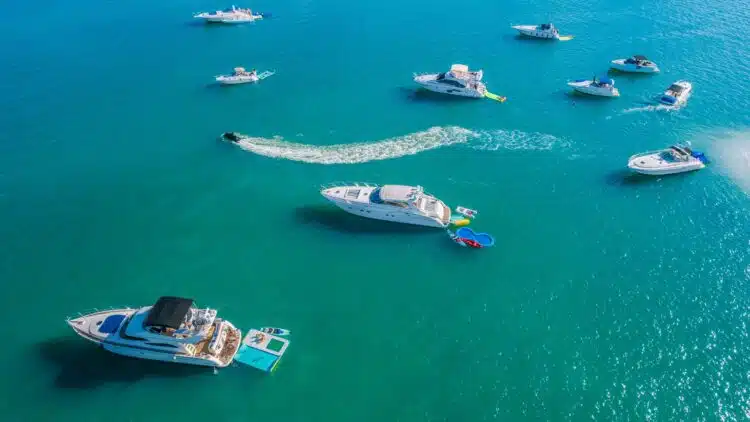
At high speed through an anchorage bay, passing close to swimmers and anchored yachts: a SeaHelp member complains about reckless jet ski riders in Croatian waters. Yet the rules are clear – and have been partly revised since 2025. In light of recent events, SeaHelp once again explains what applies to jet ski riders and why particular caution is required, especially in anchorage bays.
“Many jet ski riders don’t stick to it and drive carelessly close to boats”, writes a SeaHelp member after this year’s Croatia cruise. He was particularly struck by the behaviour in Vela Luka Bay near Murter and on the eastern side of Kaprije. Warnings from other water sports enthusiasts to slow down were partly ignored.
An isolated case? At the very least, the underlying problem is known to the Croatian authorities. During the high season, popular bays see swimmers, SUP riders, kayaks, dinghies, sailing and motor yachts, as well as fast motorised water sports equipment, converging in a confined space. Jet skis in particular can quickly become dangerous due to their high acceleration and manoeuvrability. Croatian law leaves little room for interpretation here.
Within 300 metres: a maximum of eight knots applies
The most important rule is found in Article 50 of the Croatian Ordinance on the Safety of Maritime Navigation (“Pravilnik o sigurnosti pomorske plovidbe…”, Narodne novine NN 52/2025). According to this, all watercraft must move with special caution within 300 metres of the coast, in narrow channels, and in the approaches to ports and anchorages, and must not exceed a speed of eight knots. Navigation must not endanger other water users.
For jet skis, a further, decisive rule applies: motorboats and water jet craft – the legal text explicitly names “skuteri” and “jet ski” – may only plane at a distance of more than 300 metres from the coast. And even there, this only applies provided no additional planing ban exists for the sea area in question. The responsible Lučka kapetanija, i.e. the port or harbour master’s authority, may also impose further speed restrictions for individual areas.
This makes the situation in a typical Croatian anchorage bay quite clear: an anchorage bay is not a jet ski racetrack.
What matters is not just the speedometer
Even more important for the case described by the SeaHelp member is a second rule. Under Article 48 of the ordinance, speed must generally be chosen so that the wash caused by one’s own vessel does not endanger or damage other vessels on the water or on the coast, or facilities on land.
And Article 49 goes even further: watercraft must be operated at all times in such a way that their movement and manoeuvres do not endanger human life, property, the coast, the marine environment, or the safety of other water users.
This is crucial in practice. Anyone who passes closely by an anchored yacht, a dinghy, or a swimmer on a jet ski cannot simply rely on formally having stayed under eight knots. Speed, distance, and manner of riding must be appropriate to the specific situation.
The 300-metre rule is no free pass either
Conversely, exceeding the 300-metre limit by no means automatically means: full throttle. Outside the zone, planing is generally permitted, provided there is no local ban. However, the general rules of due care and the collision regulations naturally continue to apply.
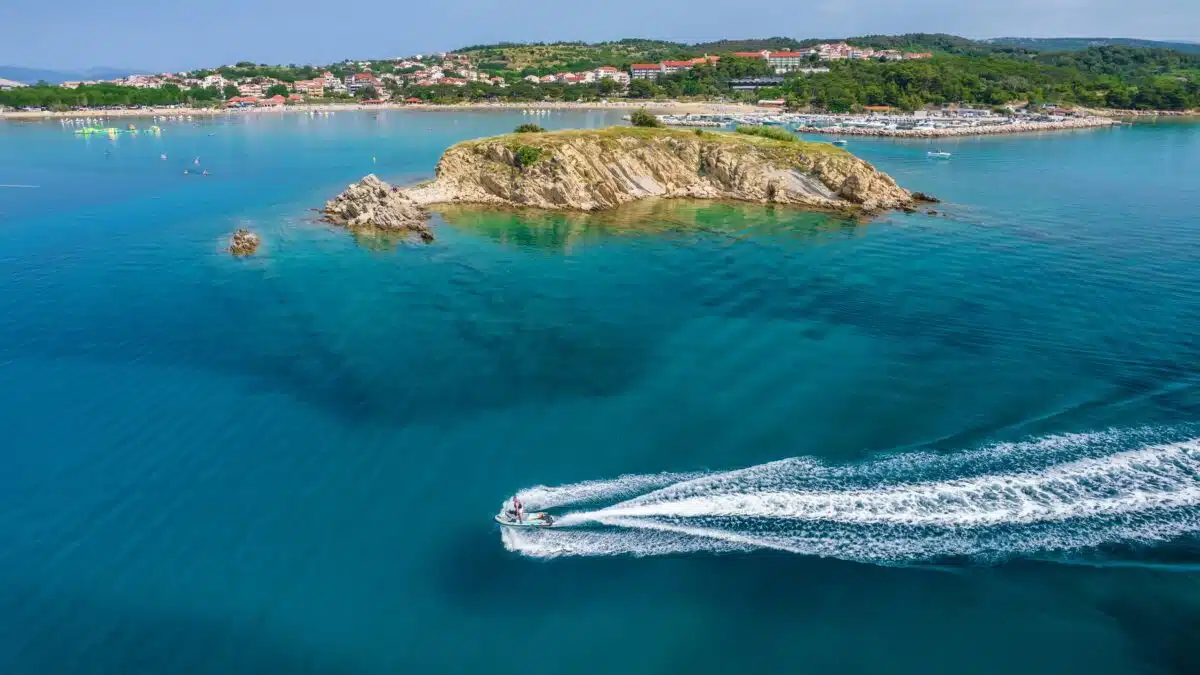
Particular attention is also required in bathing areas. The Croatian safety ordinance, amended again in 2026, generally sets a minimum distance of 50 metres from the boundary of a designated bathing area for vessels under 15 metres; correspondingly greater distances apply to larger vessels (see our news on this topic).
In addition, local port authorities may impose further restrictions. Anyone using a jet ski should therefore find out locally about signposted prohibited zones and the information given in official nautical publications.
Life jacket, helmet and quick-stop are mandatory
There are also clear rules regarding personal safety equipment. Under the Croatian Ordinance on Boats, Watercraft and Yachts (“Pravilnik o brodicama, čamcima i jahtama”), persons on a personal watercraft must wear a life jacket and a protective helmet, as SeaHelp recently reported.
In addition, a jet ski must be equipped with a safety lanyard or safety cuff, which must be connected to the rider while underway. If the rider falls into the water, this stops the drive or engine.
This is by no means bureaucratic pedantry. The Croatian Ministry of Transport documented, for example, a serious jet ski accident near Vrsar, in which a rider fell into the water after riding over the wake of a motorboat ahead of him. According to the ministry, the man was not wearing a life jacket.
Croatia is inspecting – and collecting fines
The fact that the regulations are not just on paper is shown by the regular targeted inspections carried out by the port authorities. During the “Sigurna plovidba 2026 Rijeka” operation on 16 July 2026, 22 port authority staff inspected 81 vessels and found 13 violations. A total of €4,563 in fines were imposed.
A particular focus was explicitly placed on checking impermissible speeds in areas with speed restrictions. The Croatian Ministry of Transport announced further inspections during the peak nautical season.
Previous inspection campaigns have also shown that unauthorised planing within the 300-metre zone is among the violations regularly identified.
SeaHelp’s advice: throttle is taboo in the bay
Jet skis are part of water sports – and when used correctly, there is nothing wrong with the fun of riding them. However, the enormous acceleration of modern craft calls for more consideration, not less.
SeaHelp therefore recommends a simple rule of thumb: in ports, anchorage bays, and everywhere else where swimmers, SUPs, kayaks, dinghies or anchored boats are present, significantly reduce speed and ride with as little wash as possible. Do not pass closely behind yachts, avoid slaloming between anchored boats, and keep sufficient distance from swimmers and small watercraft.
Anyone wishing to ride more energetically should first leave the bay at slow speed and safely cross the 300-metre limit. Only afterwards – provided there is no local restriction and traffic conditions allow – may planing take place.
SeaHelp Managing Director Wolfgang Dauser: “Regardless of the catalogue of fines, one person’s fun ends where it becomes a danger to someone else.”