








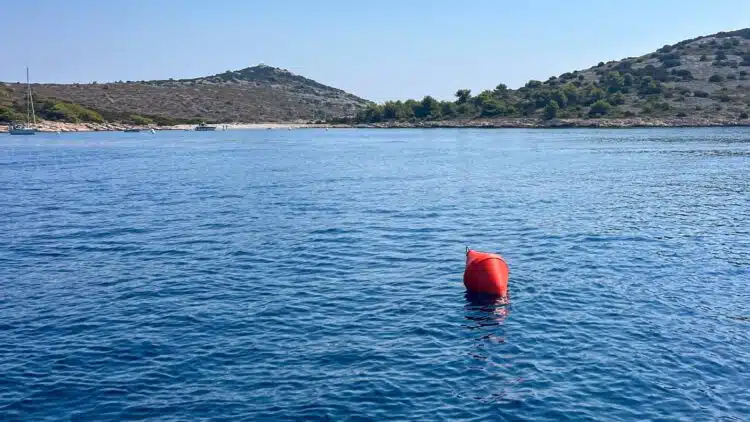
Two current navigational warnings affect popular cruising areas in the Croatian Adriatic: an explosive device has been discovered in the sea off the west coast of Istria, while around the island of Žirje three new measuring stations are causing restrictions on anchoring. No end date has yet been published for either warning. SeaHelp advises: skippers should therefore know the positions and safety distances.
Istria: 100-metre exclusion zone around explosive device
Particular caution is currently required on the west coast of Istria north of Luka Dajla. The Croatian Hydrographic Institute HHI reports, in its Croatian Hydrographic Institute HHI: Navigational Warning No. 324/2026 published on 1 September 2026, an “explosive device” found there.
The approximate position given by the HHI is: 45°21.850′ N / 013°32.417‘ E. All activities at sea within a radius of 100 metres of this position are prohibited. The regulation therefore applies not only to passage, but also, for example, to anchoring, swimming, diving, snorkelling or fishing. The official wording is unambiguous: “All activities at sea” are prohibited within the 100-metre radius. Source: Hrvatski hidrografski institut (HHI), Radio Navigational Warning 324/2026, as of 7 September 2026.
For leisure skippers, this means in practice: “The position should be entered into the plotter or navigation app before setting off, and a distance significantly greater than the prescribed 100 metres should be maintained,” advises Denis Lipovac from the SeaHelp operations centre in Punat. Since the HHI explicitly refers to an approximate position of the explosive device, the stated radius should on no account be pushed to the last metre.
As to when the explosive device will be removed, caution is currently advised when it comes to forecasts. The HHI states neither a date for defusal or recovery, nor a date on which the restriction is to be lifted. Warning No. 324/2026 is still listed as a valid navigational warning as of 7 September. Only once it is officially lifted should the area again be considered “clear”.
The navigational warning also provides no information on the type, size or origin of the explosive device. Whether it is, for example, old ordnance from a past war cannot therefore be stated with any certainty at present. “For skippers, what matters above all is: keep your distance and under no circumstances attempt to search for, dive on or examine the object more closely yourself,” says Denis Lipovac.
Žirje: three new measuring stations in popular bays
The second warning is less dramatic, but in practice is likely to affect considerably more leisure skippers. Since the end of August, three automatic ADCP current-measuring stations have been located around the island of Žirje off Šibenik.
The HHI lists them in its Navigational Warning No. 320/2026 of 31 August 2026. The stations are located in or near Uvala Stupica Mala and Uvala Kabal, at the following positions:
- A: 43°38.029′ N / 015°42.280′ E – open in OpenSeaMap
- B: 43°37.665′ N / 015°42.620′ E – open in OpenSeaMap
- C: 43°37.868′ N / 015°42.816′ E – open in OpenSeaMap
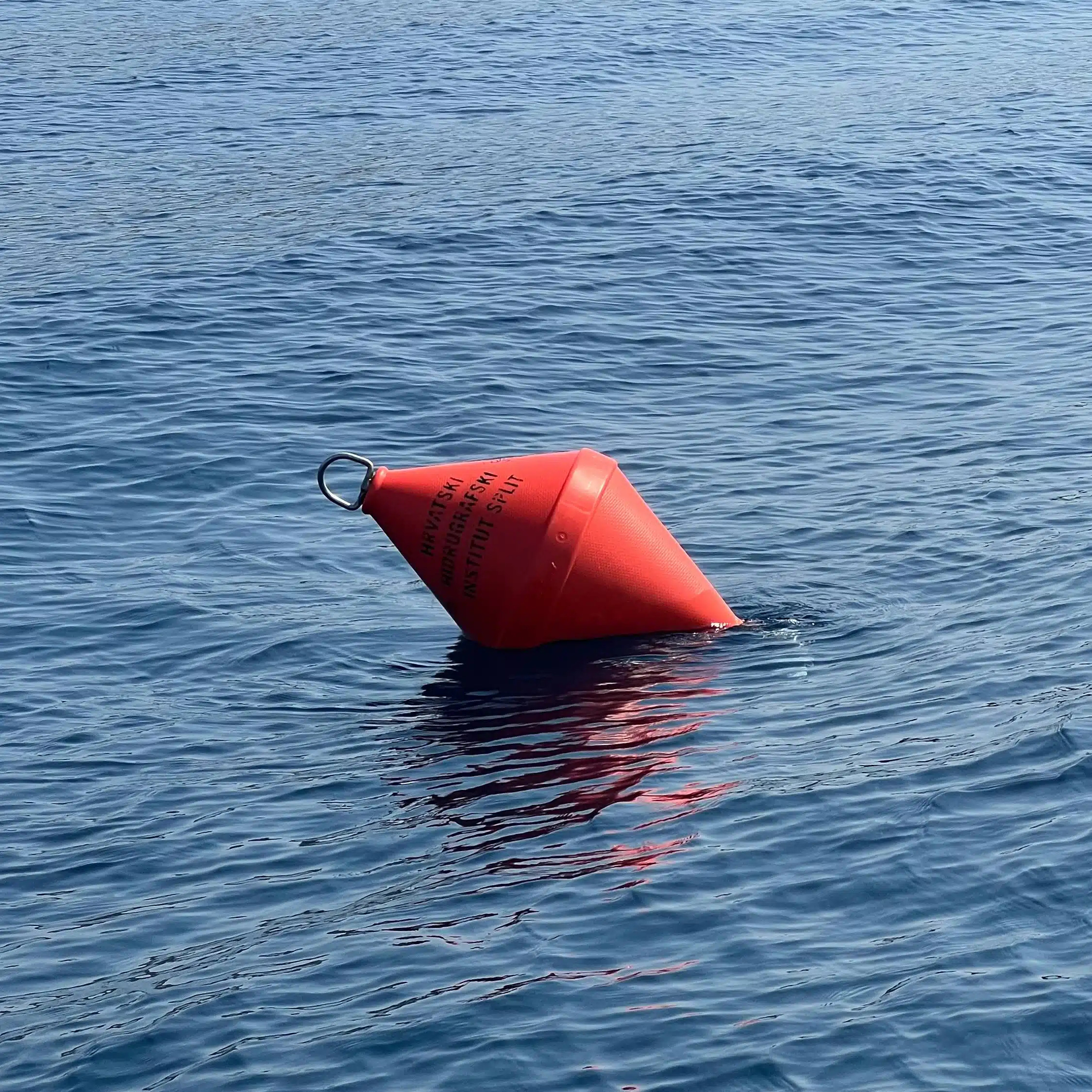
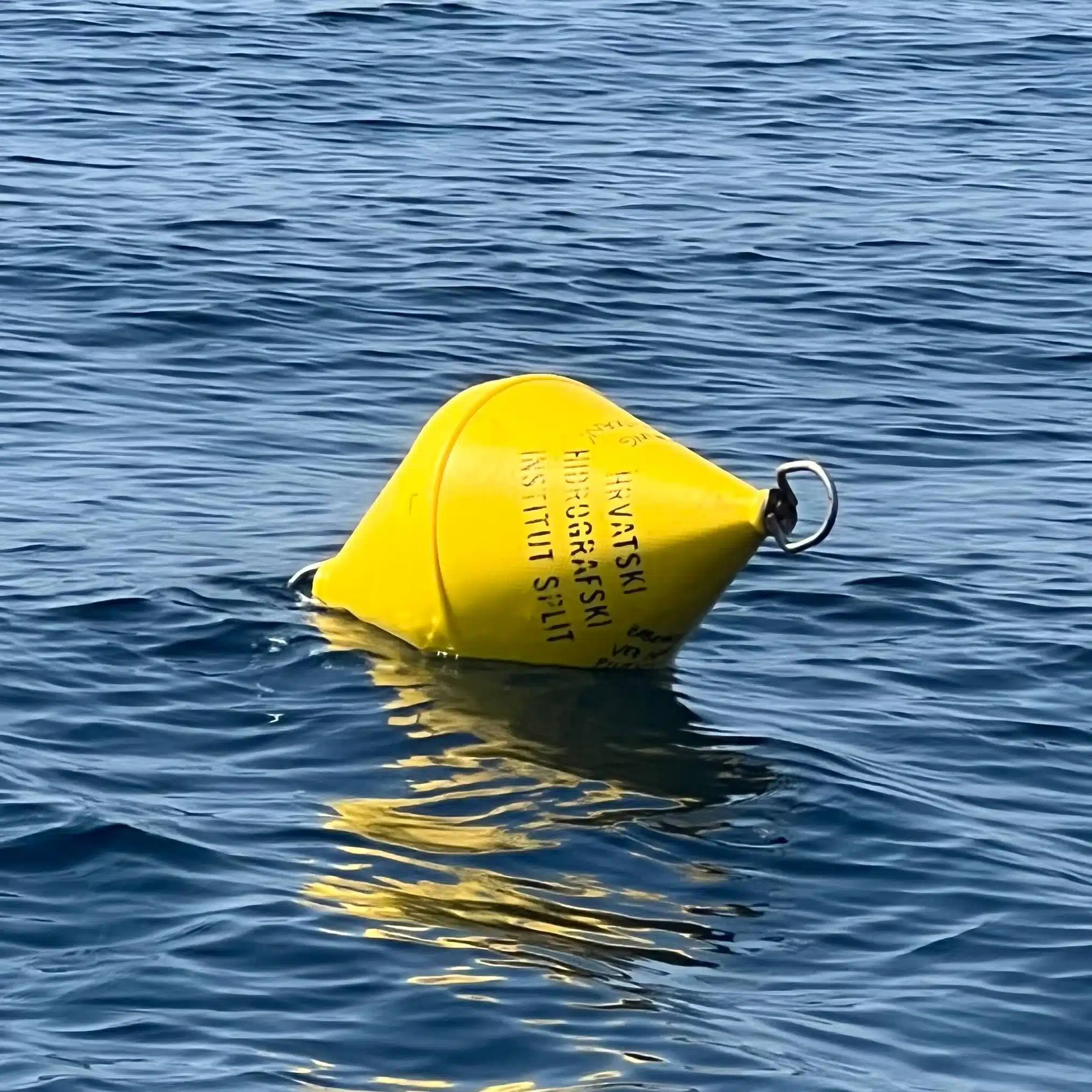
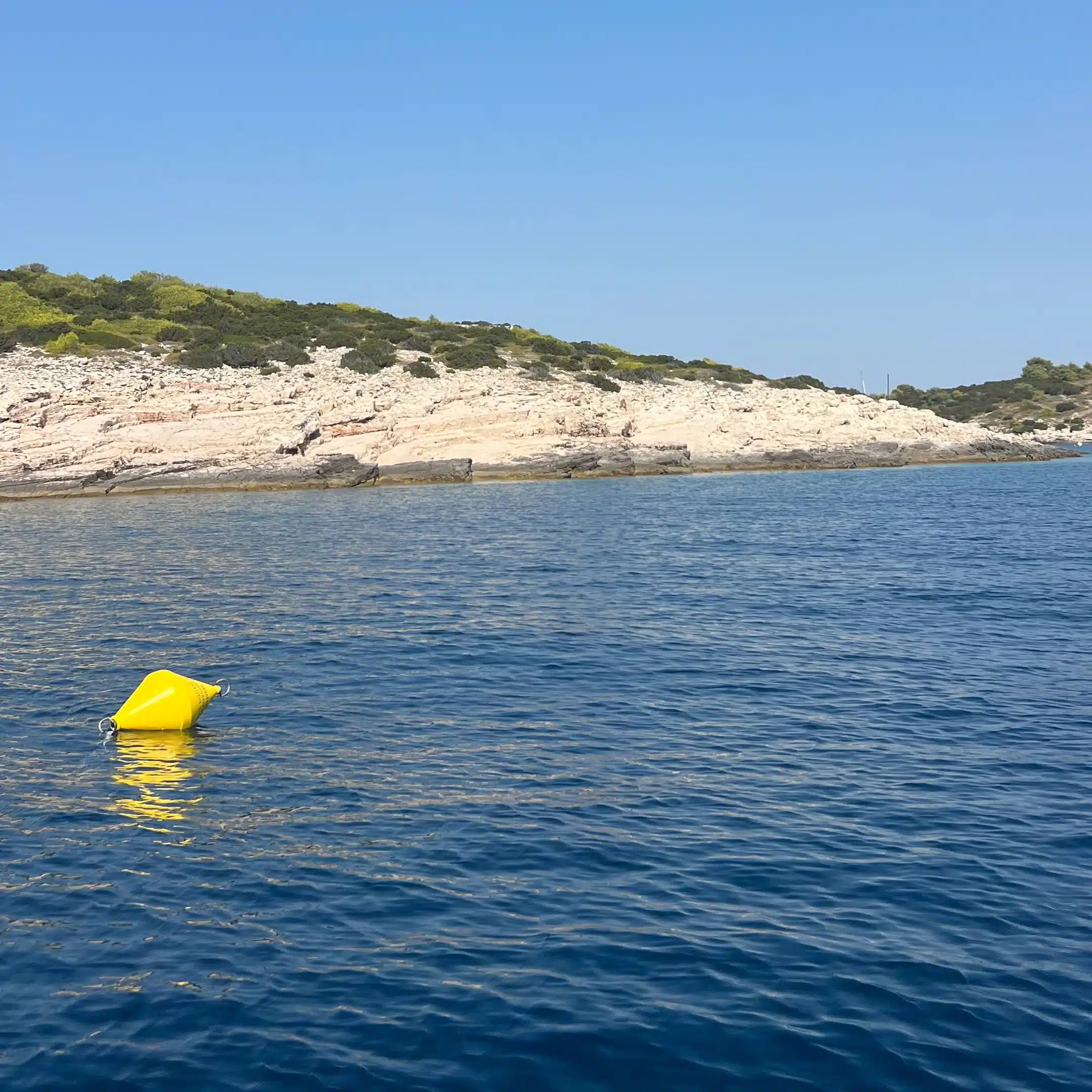
All position data refer to WGS 84. Each measuring station is marked with a red-and-yellow buoy, as stated by the Hrvatski hidrografski institut (HHI) in its Radio Navigational Warning.
An important difference from the explosive device: the area itself is not completely closed to shipping. Instead, the HHI merely requires vessels to pass through carefully and at reduced speed. Mooring to the measuring buoys is expressly prohibited. Anchoring within a radius of 50 metres of the stations is likewise prohibited.
This is particularly important for crews familiar with Žirje. The island’s bays are popular as anchorages. A red-and-yellow buoy must therefore on no account be mistaken for a free mooring or berthing buoy. Anyone anchoring there should also pay attention not only to where their own anchor falls: the yacht’s swinging circle should sensibly also be chosen so that the boat does not swing into the protected area of the measuring station.
What actually is an ADCP?
The somewhat unwieldy abbreviation stands for Acoustic Doppler Current Profiler, roughly translated as “acoustic Doppler current profiler”. The device measures the speed and direction of water currents at different depths.
In simplified terms, the principle resembles the well-known Doppler effect of a passing train. An ADCP sends sound pulses into the water. These are reflected by small particles in the water. From the frequency shift of the returning signal, the device can determine how fast and in which direction the water is moving. In this way, it is possible not only to determine a single current speed, but to build up a genuine current profile through various depth layers. The US ocean authority NOAA describes ADCP according to exactly this principle.
Such devices are often anchored for several weeks or months to collect longer-term current data. NOAA, for example, cites typical measurement periods of one to four months for its own current measurement campaigns. However, this allows no conclusions to be drawn as to how long the three Croatian stations off Žirje will actually remain in place – no corresponding official information is available for this as yet.
How long will the buoys remain off Žirje?
Here too, the official position is currently clear – or rather, precisely not, because: no end date is given in the Croatian navigational warning. Unlike time-limited works, for which the HHI explicitly publishes a start and end date, Warning 320/2026 contains only the positions and rules of conduct for the three stations. The warning remains active as of 7 September 2026.
Skippers should therefore assume that the 50-metre anchoring ban, the mooring ban and the requirement to pass slowly and carefully will apply until further notice.