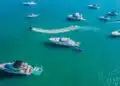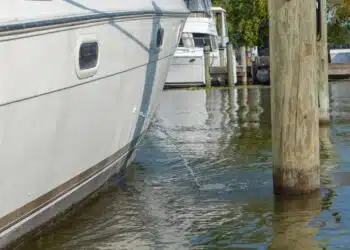










Once again, a yacht has been “washed up” at Playa Son Maties near Palmanova by wind and waves. However, the phenomenon that yachts—including quite large ones—strand relatively frequently at this location in the southwest of Mallorca is no mystery, but can be explained by the combination of weather conditions, currents, geography, and apparently insufficient caution.
Palmanova is an extremely popular seaside resort among tourists in the southwest of the Spanish Balearic island of Mallorca. The town, which belongs to the municipality of Calvià, is located in the Bay of Palma, about 15 kilometers west of Palma, directly on the sea. To the east of the bay lies Portals Nous, to the west Magaluf. In the area of Palmanova are the two beaches Platja des Carregador and Playa Son Matias, connected by a long beach promenade.
You are currently viewing a placeholder content from Google Maps. To access the actual content, click the button below. Please note that doing so will share data with third-party providers.
© Google Maps
For several years now, beachgoers at Playa Son Maties have been witnessing a free spectacle: every year since 2022, at least one yacht has run aground off Palmanova; sometimes sailing yachts, sometimes luxurious motor yachts end up there involuntarily and are marveled at by bathers and beach walkers.
This year, too, a yacht ran aground again at Platja Son Matjes: “comes autumn, comes the wreck: The next sailboat lies off the holiday beach Son Maties in Palmanova”, titled mallorcazeitung.com on December 6; however, this was “not an isolated case, but part of a recurring phenomenon”. Thus continuing a “good old tradition in the southwest of Mallorca”. This time it was an “old boat that had apparently not been maintained for a long time”.
In the past nine years, at least seven yachts have run aground on exactly this stretch of coast
With the word “phenomenon”, the authors describe the fact that almost annually—namely at least seven times in the past nine years—yachts have run aground on exactly this stretch of coast. Some observers even speak of a “mystery” in this context. A yacht flying the German flag ran aground on the beach of Son Matíes in Palmanova in the southwest of Mallorca, reported mallorcamagazin back in July 2016. Under the eyes of numerous bathers, sea rescue had to intervene and pull the luxury vessel off the beach.
“Yet again a boat is washed up at Playa Son Maties”, titled mallorcazeitung.es just in April of last year: a sailboat had run aground at Playa Son Maties in Palmanova. The ship had “apparently been driven ashore by the rough sea”. Only a year earlier, in September 2023, an eleven-meter boat had been washed ashore by storm gusts, where it “lay listing for days and became an attraction for bathers and passers-by”.
In the case of a (sailing) yacht that ran aground in Son Maties in February 2019, the Calvià town hall had to free up around 80,000 euros from its 2020 budget to scrap a 22-meter yacht. During the months it lay on the beach, the boat had been covered in graffiti and looted.
The scrapping process was described as “complex”: “after a first phase in which the structure was inspected, all hazardous substances were removed. Then parts of the furniture and household appliances were removed. Finally, the hull was dismantled and cut into several pieces to facilitate transport”, wrote mallorcazeitung.es at the time.
Another “ghost” yacht (in addition to a sailing yacht, see above) had run aground off Palmanova in 2019: “Residents of Palmanova in the southwest of Mallorca are increasingly upset about a yacht that ran aground there in April and still hasn’t been cleared away”, reported mallorcamagazin.com in October 2029. It reportedly involved a “relatively large motor ship” that had lain on the beach for months.
And in April 2022, inselradio.com reported that police on Mallorca had tried to locate the owner of a ship that had run aground on the beach of Portals Nous between the dolphinarium and the tennis club. The “Reina I” had reportedly run aground first and was then driven to the coast by strong winds. By November, the stranded ship was finally completely destroyed by wind and waves.
Why do yachts—including some quite large ones—run aground relatively frequently at Playa Son Maties near Palmanova of all places?
What is the reason that yachts—including some quite large ones—are washed up relatively frequently at Playa Son Maties near Palmanova of all places? Well, it is clear that this is by no means a “mystery”—rather, most of these stranding cases can be explained quite plausibly.
For instance, in the case of the medium-sized blue luxury motor yacht stranded in 2016, it turned out later that the yacht had originally been moored to another yacht. “Both had stopped for a while near the beach together”, wrote the Spanish daily newspaper Ultima Hora at the time; when they wanted to leave around five in the afternoon, they released the mooring lines, one of which fell into the water and got caught in the propeller. The boat subsequently drifted off and was driven to the beach.
Furthermore, various media repeatedly report that strong storms or gales tear yachts loose in the southwest of Mallorca—as happened in the spring of 2019, when several boats were torn loose by wind and waves, including one of the two yachts that stranded at Son Maties.
In 2024, too, in addition to sea rescue services, various yacht magazines reported that during violent storms—caused among other things by weather phenomena such as “Gota Fría” or DANA—dozens of yachts had been washed ashore in the Balearics, including a sailing yacht off Palmanova.
Gota Fría (Spanish for “cold drop”) and DANA (Depresión Aislada en Niveles Altos, “isolated depression at high levels”) describe in this context the same extreme weather phenomenon in the Mediterranean region, where an isolated drop of cold air at high altitude meets warm, moist Mediterranean air and leads to violent, often catastrophic heavy rainfall events and flooding, typically in autumn.
While Gota Fría represents the general term for the phenomenon, DANA emphasizes the meteorological cause (the high-altitude depression) that was responsible for severe storms like the tragic floods in Valencia in October 2024.
Often it is a combination of strong wind, powerful waves, and suddenly rising seas that lead to anchors slipping or lines breaking, for example
Often, however, it is simply a combination of strong wind, powerful waves, and suddenly rising seas that could lead to anchors slipping or lines breaking—with the result that the yachts drift and finally land on the beach. Often the chosen anchorages and the shelter situation are inadequate—if a lee shore situation is added to this, disaster is often pre-programmed.
Besides examples of poor seamanship, the increasing frequency of extreme weather events also plays a not insignificant role in the increasingly occurring strandings—storms and severe weather in the Balearics are apparently increasing in frequency and intensity—partly because warm sea surfaces and moist summer air meet cold air masses (SeaHelp reported here). This increases the risk for pleasure boats and yachts, especially when they anchor in supposedly quiet bays and underestimate the weather development.
In addition, Mallorca is particularly susceptible to weather changes in spring and autumn. Typical features of this are Mistral / Tramontana-like winds from the northwest to north, which arise during cold air advances over the Mediterranean and can generate strong seas, especially on the west and southwest coasts of the Balearic island. Western storm fronts or low-pressure cells (e.g. Gota Fría / DANA, see above) can move in from the west or southwest—then waves and wind hit protected bays like the Bay of Palma or their beaches directly.
Finally, currents and wave reflections also play a role: in shallow bays with sandy beaches, the combined effect of pushing wind, reflected waves, and rapidly rising surf can quickly lead to boats being inevitably pushed towards the coast. Because such weather situations occur frequently in autumn and spring, the risk for yachts is correspondingly higher during this time.
Palmanova / Son Maties is located in a relatively closed, shallow bay with a sandy beach, which can become a natural “catchment basin” for drifting boats during storms (esp. from the southwest)
But why Son Maties / Palmanova of all places, many observers ask. A plausible reason could be that Palmanova / Son Maties is located in a relatively closed, shallow bay with a sandy beach, which can become a natural “catchment basin” for drifting boats during storms (esp. from the southwest).
Moreover, the bay is also a popular anchorage / mooring spot: many pleasure boats and private yachts move to such sheltered bays in supposedly good weather—often with shallow drafts, which makes them particularly vulnerable in rough seas—if skippers underestimate the risk of a weather change or if there is a lack of necessary precaution.
You are currently viewing a placeholder content from Google Maps. To access the actual content, click the button below. Please note that doing so will share data with third-party providers.
© Areaspective | Google Maps
Conclusion: the strandings are by no means a “mystery”; storms and currents are often the main reason for them. The fact that yachts strand at this spot “pretty much every year” suggests that weather extremes, insufficient securing, and shallow coastal structure interact. Furthermore, the bay off Palmanova is quite unprotected and unsafe, especially during strong winds from the southwest.
Anyone who anchors there anyway—or wants to anchor—should: always follow the weather development and keep an eye on weather warnings, especially regarding expected storms in spring and autumn. In the event of a suddenly rising storm, one should leave the bay immediately and head for deeper water, or immediately head for a safe, sheltered port.