








The wording “unforeseen damage caused from outside” is a central concept in insurance law – especially in hull insurance for motor vehicles, yachts and boats – for delimiting covered risks. It defines which events are considered “insured accidents” or “insured damage”. In the following, Robert Perger from SeaHelp Insurance explains the legal meaning in detail.
“Unforeseen” – What does that mean legally?
A loss is unforeseen if neither the policyholder nor an insured person could have foreseen or expected it in time from an objective point of view. Loss is defined as any involuntary financial loss caused by a damaging event.
The key legal message: The yardstick for assessment is an objective, reasonable policyholder. The event must not have been planned, intended or certain to be expected. Negligence does not necessarily rule out foreseeability, even gross negligence often does not, unless this has been explicitly excluded. Intent, on the other hand, always excludes insurance cover (§ 81 VVG).
Examples of “unforeseen” / “not unforeseen”
Examples of “unforeseen”:
- a sudden collision with a wild animal (motor vehicle) or flotsam (boat)
- an engine fire the cause of which was unknown to the keeper / owner
- suddenly running onto an underwater obstacle that is not visible (yacht)
Examples of “not unforeseen”:
- slowly progressing wear and tear
- corrosion
- ageing processes
- known risks that the policyholder deliberately ignores (e.g. continuing to drive despite a red warning light)
What does “caused from outside” mean?
This component delimits hull cover against self-wear and internal defects. A loss is caused from outside if an external event acting on the vehicle / yacht / boat directly triggered the damage.
Examples of “caused from outside” / “not caused from outside”
Typical examples of the category “caused from outside”:
- collision with another vehicle or object
- lightning strike
- storm
- hail
- flood
- impact in the water (flotsam, grounding)
- sabotage or vandalism
- animal bites can also fall under this category – depending on the conditions
Typical examples of the category “not caused from outside”:
- pure machine or engine damage without external influence (e.g. piston seizure, material fatigue)
- wear and tear
- rust
- osmosis (in boats)
- material defects
- so-called “internal operating processes”
Consequently, this means: no hull compensation without external influence – unless the internal defect subsequently leads to an accident, which can then count as an external influence.
Interaction of both elements
Important: for hull cover, both criteria must be present simultaneously, i.e. an “unforeseen” (not expected or intended event) must go hand in hand with “caused from outside” (external mechanical, physical or other influencing factor).
Examples that fulfil both criteria:
- a car is hit by an unknown vehicle while parked
- mast breakage of a yacht due to a sudden gust
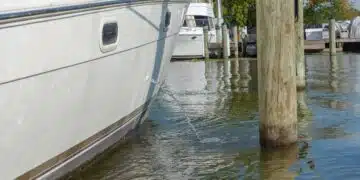
- during trailering: wind gust pushes the boat sideways against a pile
- collision with a floating object
Examples that do not fulfil one criterion:
- only “unforeseen“: engine burns due to short circuit (damage may still be covered here, however, because fire can be counted as an “external event”)
- only “caused from outside“: regular wave movement causes osmosis (damage not covered because foreseeable / typical)
- neither of the criteria: wear on the shaft / propeller (no insurance cover)
Legal basis
The terms discussed do not appear explicitly in the law in this way, but originate from various legal sources, for example from the General Conditions for Motor Vehicle Insurance (AKB) and the General Conditions for Water Sports Hull Insurance (AVB) in conjunction with long-standing German case law (including BGH, OLGs).
For example, there are central legal principles from constant case law on “unforeseen” = sudden and accidental from the perspective of a reasonable policyholder (see above) and “from outside” = not originating from the vehicle’s or boat’s own operational sphere. The distinction is important because it serves to separate hull insurance from warranty / or mere wear and tear risks, which are not covered.
Differences motor vehicle hull vs. yacht / boat hull
If one focuses on the similarities and differences between motor vehicle hull insurance and yacht / boat hull insurance, both require an unforeseen, external influence, and both exclude wear and tear and internal operating damage.
With regard to the differences, it should be noted that in boat hull insurance, water-related risks such as grounding, contact with flotsam, etc. are often specially regulated. Osmosis (osmotic blistering in GRP boats), on the other hand, is almost always excluded. Motor vehicle hull insurance, on the other hand, typically has a stricter distinction between partial hull and comprehensive hull (e.g. damage caused by game, glass breakage, storm).
The three most common claims covered by hull insurance
“The three most common claims covered by boat hull insurance are grounding (running aground), collision and foreign object damage as well as storm and elemental damage,” says insurance expert Robert Perger from SeaHelp-Insurance.
Grounding (running aground) is the “classic” and happens quickly, especially in unknown or shallow coastal waters. Definition: The yacht runs aground (sandbank, rocks, shoal). Damage pattern: Hull damage: scratches, cracks, holes in the keel or rudder area. Rudder damage: damage to the rudder blade or rudder bearings. Engine / propeller: damage to propeller, shaft or saildrive housing if these touch the ground.

Cover: Hull insurance covers the costs of repairing the hull, keel, rudder and affected engine parts, even if the grounding is due to a navigational error by the skipper (provided there is no gross negligence accepting the damage).
Collision and foreign object damage refers to damage caused by contact with another object – whether in harbour, under way or at anchor mooring. Definition: Contact with other ships, buoys, dolphins, jetties, or hitting flotsam (foreign object damage). Damage pattern: In harbour: Hull damage due to entering or casting off (e.g. due to strong crosswind maneuver). Under way: Damage due to collision with another ship (often this is also a case for the opposing liability insurance, but own hull insurance may pay faster in unclear cases and may then take recourse). Flotsam: Damage due to hitting containers, logs or other large objects at the waterline, propeller or rudder.

Cover: Hull insurance covers the repair costs for the yacht, even if the skipper had a moment of inattention that led to the collision.
Storm and elemental damage are considered unforeseeable under insurance law and caused by forces of nature. Definition: Damage caused by strong wind, hail, lightning strike, fire or sinking of the yacht due to water ingress (e.g. due to a hatch damaged by the storm). Damage pattern: Rig damage: mast breakage, bent shrouds, damage to sails due to overloading in the storm. Hull / superstructure: damage caused when the yacht hits the jetty in the harbour or is damaged by a wave. Lightning strike: destruction of the entire on-board electronics and navigation. Tarpaulin: Often the tarpaulins and poles are bent or completely gone. It should be noted here that many companies replace the tarpaulins either fully or proportionately if they were not yet too old (deduction for age).

Cover: Hull insurance is indispensable here, as no one can be held liable for the weather. It covers the high costs of repairing or replacing the rig, electronics and any salvage costs in the event of a total loss.
Further information and contact:

Robert Perger SeaHelp Contact person for yacht insurance
Tel: +43 (0) 7617 – 21921 Email: insurance@sea-help.eu Further information HERE