







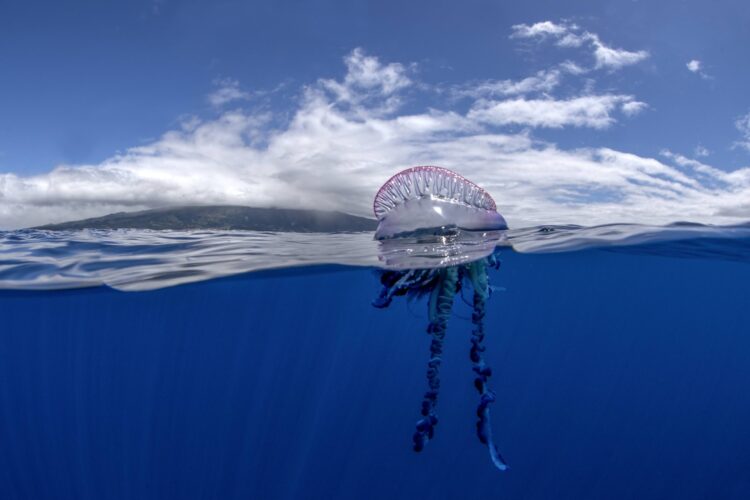
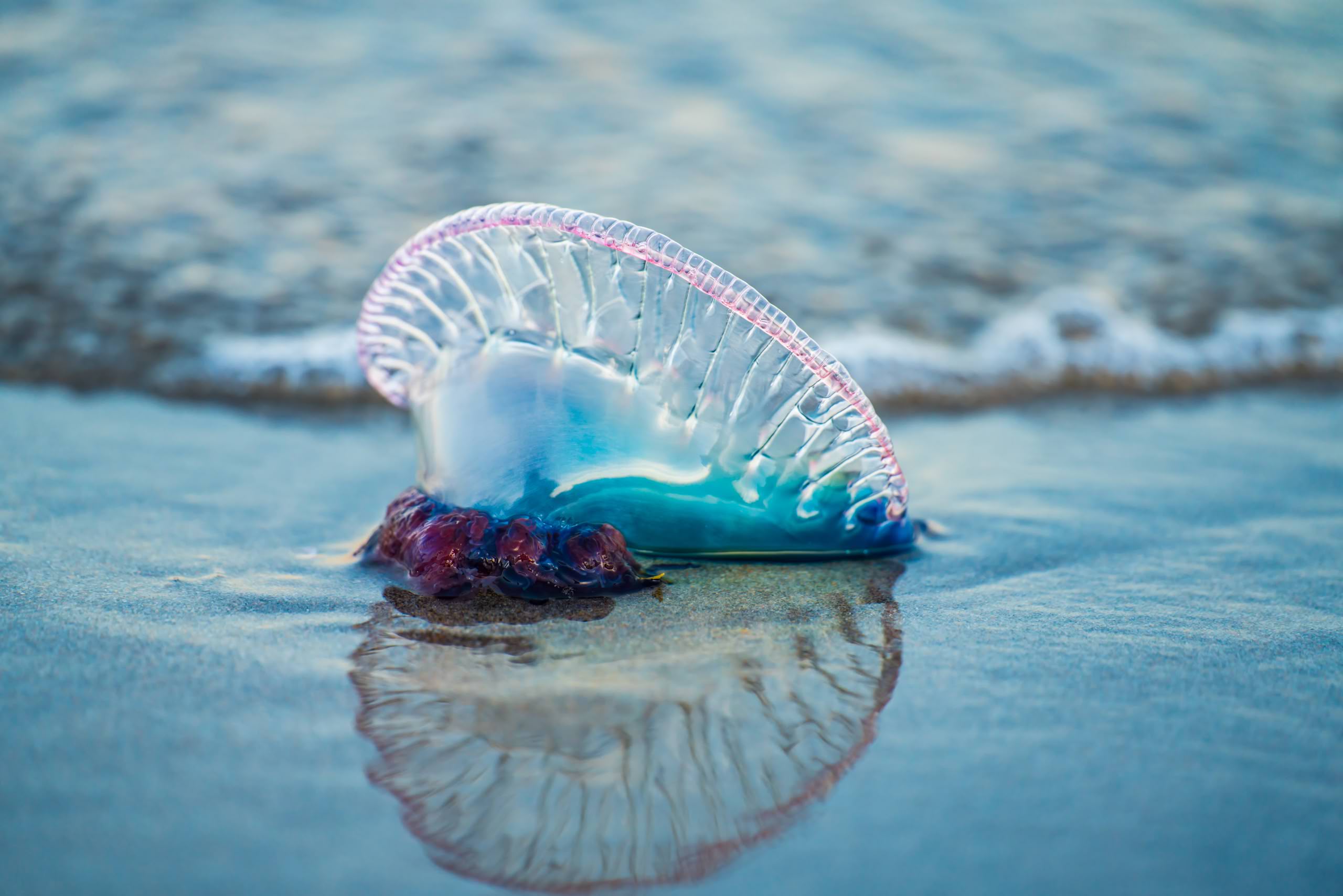
It looks almost too beautiful to be dangerous. A small, blue-violet shimmering body drifts on the surface of the water, above it rises a translucent crest like the sail of a tiny ship. But anyone who swims closer out of curiosity during a swim stop should quickly gain distance: the Portuguese man-of-war is one of the most unpleasant encounters you can have in European coastal waters.
In July 2026, numerous specimens of Physalia physalis were reported along Spain’s northern coast. Beaches in Bizkaia and Gipuzkoa in the Basque Country were particularly affected; within just a few days, 19 injuries were recorded there, and three of those affected had to be taken to a medical facility. Portuguese man-of-war also appeared off Asturias, including at the beaches of San Lorenzo, Poniente and Arbeyal near Gijón. Reports from the French Atlantic coast followed in late July and early August. There, sightings occasionally led to swimming bans and beach closures.
This is certainly relevant for skippers. That’s because Physalia physalis lives exactly where we most like to be when jumping off the stern: on the surface of the water.
Not a jellyfish – but a floating colony
Even though it is almost always referred to as a jellyfish: strictly speaking, a Portuguese man-of-war is not a jellyfish. It belongs to the siphonophores, colonial organisms made up of highly specialized individual organisms that function together as a single creature.
The most striking part is the gas-filled float, usually ten to 30 centimetres long, known as the pneumatophore. Its raised crest functions like a sail. As a result, the man-of-war cannot swim deliberately against wind and current, but is instead carried across the sea’s surface.
But hidden beneath this comparatively small “sailboat” lies the real danger: long tentacles covered in countless stinging cells. They usually extend several metres deep, or trail behind the animal; under favourable conditions they can grow considerably longer. That’s why a simple rule applies at sea: don’t just avoid the visible blue float, but keep a very generous distance.
Actually a resident of the open ocean
Physalia physalis is found worldwide in warm tropical and subtropical marine regions. For Europe, the Atlantic population is particularly relevant; in the Azores and in Portuguese waters, the species is by no means exotic. Wind and surface currents can carry the animals all the way to Europe’s Atlantic coasts.
The Mediterranean is not entirely new territory either. Scientific studies show that Portuguese man-of-war repeatedly enter the Mediterranean through the Strait of Gibraltar. Sightings have been documented since the 19th century. In most cases, this apparently does not involve a permanently established Mediterranean population, but rather animals that are carried far to the east by particular combinations of wind, current and Atlantic water.
Portuguese man-of-war were also observed in the central Mediterranean in 2026: between early February and early March, scientists documented specimens whose appearance was likely linked to an inflow of Atlantic water and particular current conditions.
So the animals don’t “migrate” to Europe in the classic sense. They sail here – or rather, are sailed here. Wind and current determine their course.
For skippers: look first, then jump
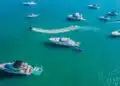
The danger is easy to underestimate, especially during a swim stop at anchor. While lifeguards at supervised beaches can raise warning flags, there is no one in a secluded bay to look out for man-of-war beforehand.
That’s why a quick look around the boat should be second nature before jumping in. A Portuguese man-of-war is usually fairly easy to spot thanks to its blue to violet shimmering float. It gets trickier with individual or torn-off tentacles – these can be almost invisible in the water.
If a man-of-war is spotted, the crew should not go swimming. Even a supposedly sufficient distance of a few metres is no guarantee, since the tentacles can extend well beyond the visible body.
Anyone who sees several animals should skip the swim stop altogether and, if necessary, choose a different anchorage. A cluster on the surface can mean that more specimens are drifting in with the wind and current.
Caution on the beach too
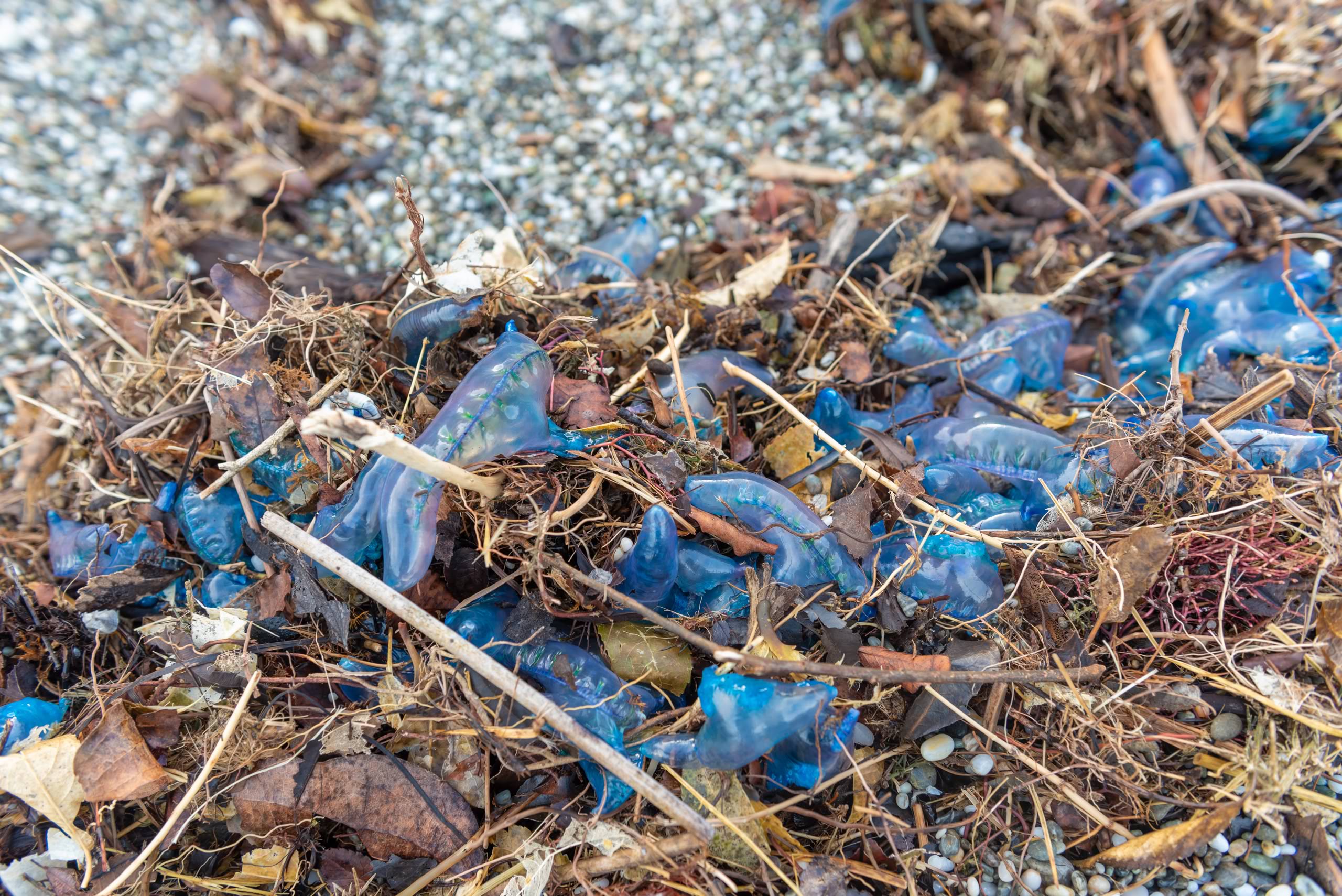
Portuguese man-of-war are regularly washed up on beaches. There, they quickly lose their elegant shape, but their stinging cells don’t automatically lose their effect. Even dead or drying animals, and torn-off tentacles, can still sting.
That’s why the rule is: never touch – not even with bare feet, a towel, or out of curiosity with your hand. This is especially important for children and dogs.
A stranded animal should not be carried back into the water yourself. At supervised beaches, inform lifeguards or beach patrol staff. If several specimens are found, this is also a clear indication that more animals may be present in the nearshore water.
Why contact is so painful
The tentacles are densely covered with stinging cells known as nematocysts. On contact, microscopically small stinging threads shoot into the skin and release venom.
Typical symptoms are immediate, sometimes extreme pain, along with long, whip-like red marks on the skin. Swelling and local inflammatory reactions may also occur.
In cases of more severe poisoning, however, nausea, vomiting, headaches, circulatory problems, shortness of breath or other systemic reactions are also possible. Allergic reactions can make the situation even worse.
This makes an incident at sea particularly problematic: anyone who suddenly experiences severe pain or circulatory problems in the water is already at risk from the resulting panic and danger of drowning.
What to do after contact?
The most important thing first: get out of the water. After that, the affected skin should be moved as little as possible and never rubbed. Any visible tentacle remnants must be carefully removed – ideally with tweezers or a suitable tool, not with bare hands. Anyone helping someone else should protect their own hands.
Seawater, or salt water, is suitable for rinsing. Fresh water should be avoided, as the change in salinity can trigger stinging cells that have not yet fired. Sand, vigorous rubbing or alcohol also have no place on the wound.
After that, heat can significantly relieve the pain. Medical recommendations for many marine sting injuries suggest warm to hot, but never scalding, water – around up to 45 degrees Celsius – applied over an extended period.
Incidentally, international recommendations regarding vinegar are not consistent for Physalia. Some guidelines explicitly recommend it for certain jellyfish species, while others advise against it for the Portuguese man-of-war. For a skipper without reliable species knowledge, the conservative approach therefore makes sense: carefully remove the tentacles, rinse with seawater, avoid rubbing, and then apply heat to relieve the pain.