

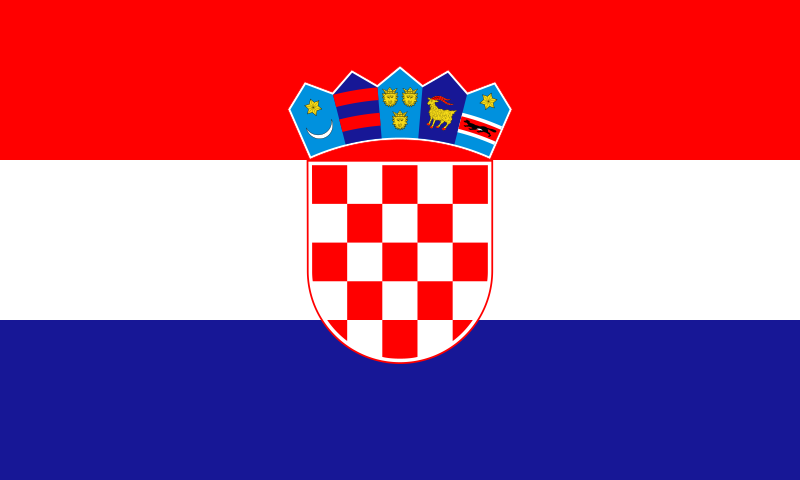








Flying flags on sailing yachts follows a long maritime tradition and is not only a matter of etiquette, but in some cases also significant in terms of national and international law – especially regarding the courtesy flag (guest country flag). Tips from the SeaHelp editorial team on the correct use of flags, Part 1.
We regularly receive questions about flag etiquette: which flags should be flown correctly on yachts, and above all: where exactly is their place on board? For this reason, here is a brief overview of the most important flags: the ensign (national flag), the courtesy flag, and the club flag or burgee.
First of all: the use of flags originates from 18th and 19th-century seafaring, when they primarily served to identify ships at sea – long before radio or AIS existed. Flying a courtesy flag developed as a polite gesture when entering foreign territorial waters. Even today, it is considered a symbol of “welcome” and “I respect your rules.”
The ensign must always be flown when the boat is underway
The ensign, also known as: National Flag (home flag) must always be flown at sea when the boat is underway, i.e., traveling or maneuvering. In foreign waters, the ensign must also be displayed visibly at all times – this, by the way, also applies when lying in a harbor (not mandatory at night, but customary).
The appropriate place to fly the home flag is the stern, as far aft as possible on the so-called flagstaff. On modern yachts that do not have a flagstaff, the ensign should be attached to the backstay or, for example, to the railing mount at the stern.
The ensign is the most significant flag on board, as it identifies the nationality of the vessel (legally relevant). Flying it is mandatory, for example, when entering another country – there it also serves as a basis for customs and authorities.
The courtesy flag is a sign of respect toward the host country (“Courtesy”)
The Courtesy flag (guest country flag) must be flown as soon as you enter the territorial waters of another state, but at the latest when mooring in the port of the host country. The flag must be flown as long as you remain in the respective territory – specifically under the starboard spreader, never on the port side.
The courtesy flag is a sign of respect toward the host country (“Courtesy”) and, beyond that, an expression of good seamanship. Authorities often look very closely to see if flags are displayed correctly – errors in flagging can certainly be interpreted as a sign of disrespect toward the host country.
Tip: The crew should always use a high-quality, clean courtesy flag – frayed flags appear disrespectful.
In Croatia, by the way, a tattered flag is not only a sign of lack of respect; a fine can certainly be due there for disparaging the state, the flag, or the coat of arms.

And… where exactly is the club burgee flown?
Skippers are also often uncertain about exactly where the club burgee or sailing club flag belongs. Skippers who want to express their affiliation with a specific sailing (or motorboat) club can fly it as long as they are on board or moving the boat.
The correct place for the club burgee or club flag is under the port spreader, never under the starboard spreader (because, as described above, this place is already reserved for the courtesy flag).
In contrast to the ensign/home country flag and the courtesy flag, there is no binding legal “must” for the club burgee or club flag; it is more of a “friendly identifying feature” among skippers, especially among sailors. They primarily want to show their identification with the club through the flag.
Correct flag etiquette can be legally relevant – and demonstrates good seamanship
Correct flag etiquette should by no means be underestimated: in a legal sense, the national flag is particularly relevant under international law. Errors here can lead to problems with customs or the police during inspections. Furthermore, incorrectly placed or entirely missing courtesy flags can be interpreted by authorities as impolite or ignorant.
And: incorrect flag etiquette is not only considered a violation of “good seamanship” among sport skippers – especially in sailing circles, close attention is paid to this, and mistakes are immediately noticed in a negative light, particularly when entering marinas or during “official” occasions. Furthermore, for example, for Croatian waters, the “Pravilnik o načinu vijanja zastave i isticanja znakova na brodovima i jahtama” (Regulation on the manner of flying the flag and displaying signs on ships and yachts) clearly mandates the flying of the courtesy flag.
Should an arriving boat “rather fly no flag at all than a badly tattered courtesy flag”? Well, that depends. Both cases initially do not demonstrate good seamanship. However, accepted practice is that anyone who, for whatever reason, does not currently have a courtesy flag on board (for example, Croatia) is still allowed to enter.
If the courtesy flag is missing, you may still enter with your yacht
Specifically: although flying the courtesy flag is prescribed, it is not an international legal requirement for calling at a country. Or put another way: if the courtesy flag is missing, there is no entry ban.
In this case, however, you must not fly any other national flag “as a replacement” or use a fantasy or signal flag instead of the Croatian flag. The principle applies: either no courtesy flag or the correct one – anything else is considered impolite or provocative.
The decisive factor in this case is rather the proper clearing in, which means: going directly to the officially designated office (in Croatia usually the harbor master’s office / Lučka kapetanija), presenting passports, ship’s papers, crew list if applicable, and correctly handling fees and vignettes. This is much more important than the flag. However, the courtesy flag should then be obtained as soon as possible. If you are inspected without a courtesy flag, you should calmly explain that the flag is missing/lost and show your readiness to obtain it immediately.