








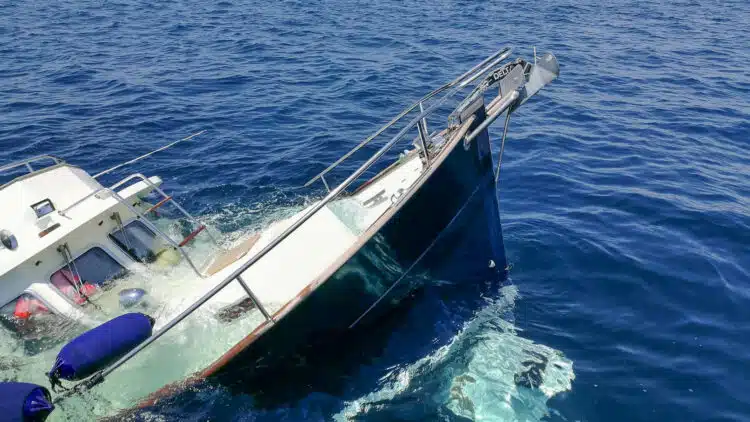
Boat hull insurance is designed to protect the owner from financial risks arising from damage to their own yacht—e.g., due to grounding, collisions, theft, storms, or lightning strikes. As a rule, boat hull insurance covers all damage that may be caused to the boat by external influences. In this article, we clarify whether this also includes the sinking of a yacht due to open sea valves or torn hoses.
How does an insurance company react if a hull-insured boat, moored in the harbor, sinks due to open sea valves because, for example, the hose behind them has slipped or is leaking? This question is likely to be particularly relevant for owners of boats whose cockpit drainage ends below the waterline.
If the valves are closed, the cockpit – and ultimately the entire boat – can fill with water and sink when it rains. If the valves are left open, a hose may slip, a clamp may fail to hold, or a hose may simply tear. This will also result in water ingress, which in the worst case can lead to the yacht sinking.
“Basically, open valves in the harbor would initially be considered negligence by the insurance company,” says SeaHelp insurance expert Robert Perger. However, if closing them is not possible due to the design, it would depend on whether the owner can prove that they have regularly checked, maintained, and replaced hoses and fittings.
The insurance company checks whether everything has been done to prevent damage
Perger: “If the owner can document this with photos or maintenance logs, that would be very positive.” This is because, in the event of damage, the insurance company would check whether everything had been done to prevent such damage. “If this were apparent, no insurance company would refuse to pay compensation,” says the insurance expert.
However, it cannot be guaranteed that the full amount will ultimately be paid; this would depend on the individual case and an overall assessment of the situation. As a general rule, however, any kind of documentation about the boat is important, and this also applies to other cases of damage.
There is often a maintenance backlog when a boat sinks due to broken hoses or an open seacock
In Perger’s experience, boats often sink due to broken hoses or open seacocks when there is a maintenance backlog; it is therefore advisable to check these areas at least twice a year and, if in doubt, to replace hoses and clamps regularly or to hire a specialist company to do so.
“In general, many modern boat/yacht hull insurance policies offer what is known as all-risk coverage, which means that everything that is not expressly excluded is insured,” says Perger, adding that SeaHelp is no different. With this form of coverage, the insurer must prove that the damage falls under an exclusion if it wants to refuse to pay. This is where the so-called reversal of the burden of proof comes into play.
However, even with all-risk insurance policies, there are regularly contractual clauses that the boat owner must fulfill, known as obligations. “If the owner violates this obligation, for example by not replacing obviously defective hoses or not carrying out regular checks, the insurance company can reduce or refuse to pay benefits,” says the head of the insurance department at SeaHelp, adding that this also applies in cases of gross negligence or intentional behavior, e.g. if an owner deliberately left the valves open even though they knew it was risky.
Sinking or water ingress is considered an insured risk by SeaHelp Insurance
“Sinking” or “water ingress” can be considered an insured risk, depending on the terms of the contract. “At Seahelp, ‘sinking’ is covered because it is not an exception,” says Perger, but coverage depends on how exactly the water entered. A sudden, unforeseeable event often requires a different approach than gradual water ingress due to poorly maintained components such as hoses, clamps, valves, etc.
“In general, the damage described can be insured if the sinking/water ingress is considered an insured risk and the policyholder has fulfilled their duty of care,” says the insurance expert. However, the insurance company will in any case “check very carefully whether the damage was caused by poor maintenance, incorrect behavior, or gross negligence.” If this can be confirmed, the insurance company may refuse or reduce the benefit in whole or in part.
Perger: “Proof of regular maintenance and inspection (e.g., maintenance logs, photos, invoices) is very helpful.” If in doubt, you should check with your insurer in advance about insured risks, coverage, and, in particular, your own obligations, the violation of which could lead to a reduction or refusal of benefits.