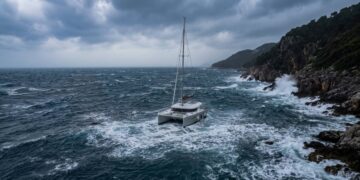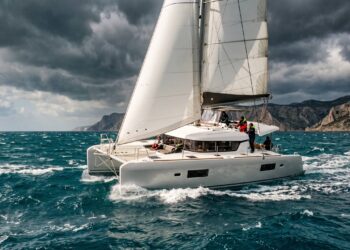

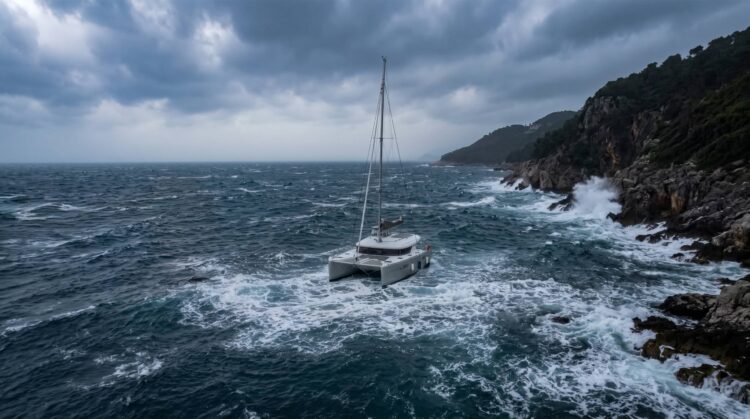
Strong Bora winds, a hazardous rocky coastline, and a stranded charter yacht: In mid-October, a sailing catamaran ran aground off the Croatian island of Mljet. All six crew members remained uninjured. The incident illustrates just how quickly a grounding can escalate into a serious hazard during foul weather. SeaHelp explains how skippers can avoid such situations whenever possible and what actions to take following a grounding.
It is Tuesday morning, October 13, 2026. A fierce Bora is blowing off the Dalmatian island of Mljet. Near the port of Pomena, a sailing catamaran carrying six people gets into difficulty and runs aground. At 10:36 a.m., a distress call is received by the Croatian Maritime Rescue Coordination Centre MRCC Rijeka. It was transmitted by the skipper of the distressed vessel.
As the Croatian Ministry of the Sea, Transport and Infrastructure (Ministarstvo mora, prometa i infrastrukture, MMPI) officially announced on October 14, the Dubrovnik Harbour Master’s Office was notified immediately upon receipt of the report. Emergency response teams from the competent Korčula branch set out straight away.
Even before the authorities arrived on scene, the crew of a private Croatian passenger vessel rushed to assist. Working together, they managed to refloat the catamaran. The vessel was subsequently secured with anchor lines to prevent severe wind gusts from pushing it against nearby rocks.
The good news: All six crew members remained uninjured. Emergency responders also determined that no water was entering the interior of the vessel. Following an initial inspection, no major damage was evident on either of the two hulls. The catamaran, owned by a Croatian charter company, was ultimately towed to a safe berth on Mljet. No marine pollution was detected.
How could this accident happen?
The crucial question is: Could the grounding have been avoided? A definitive answer is not yet available. According to the Croatian Ministry of Maritime Affairs, the competent Harbour Master’s Office on Korčula is investigating the cause of the accident. The only established fact is that adverse weather conditions with strong Bora gusts prevailed at the time of the incident.
Whether the yacht was pushed off its intended course by a gust, the safety clearance to the shoreline was insufficient, or other factors played a role remains unclarified. Reliable information regarding the speed, initial heading, and specific navigational situation is also currently unavailable.
Fundamentally, however, running aground belongs to those accidents whose risk can be significantly mitigated through meticulous passage planning, ample safety margins, and forward-looking navigation.
The Bora in particular represents a factor that must be taken seriously. This cold, frequently gusty katabatic wind can set in along the Croatian Adriatic coast with tremendous violence. Nearshore areas, passages between islands, and mountain slopes are especially susceptible to localized accelerations and shifting gusts that create treacherous conditions.
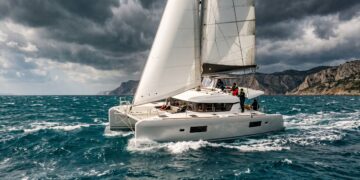
Anyone underway with a sailing catamaran in such conditions should factor in generous distances from shoals, rocks, and the coast. The reason: Catamarans feature large windage areas due to their tall superstructures. At low speeds and under heavy beam-on gusts, maintaining an intended heading with precision can become exceptionally challenging.
How can groundings be prevented?
Meticulous preparation is essential from the outset. This encompasses not only checking the general weather forecast, but specifically monitoring local wind warnings issued by the Croatian Meteorological Service DHMZ, sea state development, and conditions at the intended port of destination. When severe Bora conditions are forecast, remaining in a protected harbour is often far more prudent than undertaking a passage under time pressure.
Navigating with up-to-date nautical charts is equally vital. While electronic chartplotters facilitate orientation, they replace neither rigorous route planning nor continuous position fixes. Navigational data must be reconciled with actual visual surroundings, especially in narrow passages, near shoals, or close inshore.
In addition, configuring the depth sounder alarm correctly is imperative. Skippers must know whether the sounder reads depth below the transducer, below the keel/hull, or from the water surface. Furthermore, a shallow draft is never a license for risky navigation in shallow waters.
Another critical point: Reduce speed and sail area well in advance during heavy gusts, prepare manoeuvres early, and maintain sufficient sea room. If entering a port during foul weather is unavoidable, verify beforehand whether the harbour entrance and the designated berth can be approached safely under the prevailing conditions.
Running aground: What immediate action must be taken?
If the yacht has run aground despite all precautions, the rule is: Stay calm and assess the situation systematically. Panicked, uncoordinated refloating attempts can turn a comparatively harmless grounding into a severe maritime emergency.
First: Secure all persons on board. Immediately check whether anyone has sustained injuries. Inform the crew about the situation. Life jackets must be donned if there is significant sea state or continued hazard. No one should remain unsecured on the foredeck, along the guardrails, or between the vessel and the rocks.
Second: Inspect the engine and propulsion system. Do not attempt to force the boat free under full engine power immediately after grounding. Doing so can cause extensive secondary damage to propellers, saildrives, rudders, or the hull structure. If damage to the propulsion system is suspected, shut the engines down.
Third: Check for water ingress. Inspecting bilges, hull sections, and through-hull fittings is paramount. On monohull sailing yachts, keel attachments and structurally stressed areas require thorough scrutiny. On a catamaran, both hulls, along with the saildrive and rudder compartments, must be checked. Not all damage is immediately visible.
Fourth: Determine exact position and surroundings. Where exactly is the yacht stranded? On sand, gravel, or rock? Is there a risk from wave action? Could wind push the vessel further onto the coast? How is the water level changing? This information is critical for deciding the next course of action.
Fifth: Arrange assistance in good time. If the yacht cannot be safely and obviously freed under its own power, call for professional assistance. If there is imminent danger to life or vessel, alert the official maritime search and rescue services immediately.
The Croatian Air, Maritime and Railway Traffic Accident Investigation Agency (AIN) goes one step further in its safety recommendation AIN05-SL-5/2024: Following a grounding, a yacht should not resume navigation without a professional damage assessment, verification of seaworthiness, and clearance from the relevant maritime authorities.
SeaHelp: When can a yacht be towed free?
Not every grounding warrants an elaborate salvage operation. A vessel grounded on soft ground, for instance, can often be towed free under favourable conditions with relatively little effort.
The situation is entirely different if the yacht is resting on rocks, being pounded against the seabed by waves, or already displaying structural compromise. In such scenarios, substantial loads are exerted on the hull and drive systems. Hasty towing attempts could aggravate the situation considerably.
SeaHelp therefore clearly distinguishes between a minor grounding (free tow) and a full salvage operation. Towing free after a minor grounding is included under roadside-style breakdown coverage for active members. A more complex salvage, by contrast, must be remunerated separately.
“The SeaHelp skipper assesses the situation on site,” explains SeaHelp Managing Director Wolfgang Dauser. Seabed characteristics, sea state, yacht design, and the condition of the rig and structural components are all key considerations, says Dauser. The deciding factor is not merely that a vessel is aground, but whether it can be freed without disproportionate risk.
Even in the event of a severe grounding, SeaHelp remains the right point of contact. In such cases, however, the response may constitute a chargeable salvage operation. According to Dauser, the necessary services and estimated costs are agreed upon on the basis of a corresponding salvage agreement.
What does salvage cost – and who pays?
This distinction carries substantial financial implications for skippers and owners alike. While assistance during a minor grounding may be covered under contractual SeaHelp benefits, complex salvage operations can incur significant costs. Influencing factors include weather conditions, the vessel’s situation, the required technical assets, and the exposure to risk for responding personnel.
Skippers operating a charter yacht should notify the charter base without delay. Contacting the hull insurer or designated assistance provider is equally critical. Executing independent salvage agreements can trigger insurance complications and unexpected liabilities. However, dealing with administrative matters must never delay lifesaving interventions when acute danger exists.
Following a severe grounding, a professional damage survey and thorough documentation are indispensable. Photographs, GPS coordinates, timestamps, weather conditions, and attending rescue vessels should be logged as meticulously as possible.
How do you reach the right help in an emergency?
For technical assistance and breakdown cases where there is no imminent danger to life, SeaHelp recommends initiating contact via the SeaHelp App. The key benefit: Transmitting a service request automatically relays precise GPS coordinates, greatly facilitating vessel localization for response crews.
Alternatively, SeaHelp can be reached via the European 24-hour helpline at +43 50 43 112 or the Croatian alternative line at +385 91 911 2112. It is vital to describe the exact on-scene situation as accurately as possible.
Where immediate danger exists for persons or the vessel, official maritime search and rescue takes absolute priority. In Croatia, the Maritime Rescue Coordination Centre Rijeka is reached via emergency number 195. Distress alerts can be broadcast over VHF radio on Channel 16. Alternatively, the European emergency number 112 can be dialled.
Croatian authorities strongly advise providing concise and accurate information on position, type of accident, vessel details, number of persons on board, and any injuries when reporting an emergency.
The danger is not necessarily over after being towed free
Damage that goes unnoticed immediately after an apparently harmless grounding is particularly insidious. A stressed saildrive, a bent rudder stock, or hidden delamination in the underwater hull can trigger critical problems much later. Especially on modern production yachts featuring GRP hulls, structural damage is often entirely invisible from the outside.
Consequently, refloating from a shoal must never be taken as the end of the incident. What truly matters is verifying whether the vessel remains demonstrably seaworthy following an expert inspection.
24h EMERGENCY CALL EUROPE: 0043 50 43 112
In an emergency, SeaHelp rescue boats can be dispatched using the practical SeaHelp App, or called via the toll-free European emergency number 0043 50 43 112 (or the alternative European emergency number 00385 919 112 112).
Download SeaHelp App:


* terminal device or telecommunications service charges may apply