







Maintaining strength, flexibility and coordination even on long voyages with simple exercises.
Anyone who spends several weeks or even months at sea is by no means inactive. Quite the opposite: sailing is physical work. Hauling in halyards, stowing sails, anchoring, hauling fenders, or putting out lines in harbour – all of this demands strength and endurance. Yet the musculoskeletal system is often underused. The reason: many movements are repeated constantly, while other muscle groups are barely used at all.
On top of that comes an effect nearly every cruising sailor knows: fresh air, wind, and constant concentration increase the appetite. Anyone who eats a lot but only exercises their body in a one-sided way will gradually lose flexibility and fitness.
„You don’t need a gym or big equipment for that”, says Matt. Müncheberg. „Just ten to fifteen minutes a day are enough to maintain strength, stability and coordination”, this pays off especially on longer passages – after all, sailors always need to be able to react quickly whenever the weather or the situation demands it.
Matt. Müncheberg knows what he’s talking about – for more than 20 years, the passionate sailor has also pursued another sport, traditional karate. In fact, he holds a Dan grade and an instructor’s licence. Below are some tips from him from the world of karate that are also great for practising on board, so that sailors (and motorboaters) don’t “seize up” on long voyages.
Safety first
One simple rule applies before every workout: only do the exercises when the boat and weather allow it. In strong winds, heavy seas, or during harbour manoeuvres, fitness training obviously takes a back seat. And: training barefoot or in non-slip deck shoes is considerably safer.
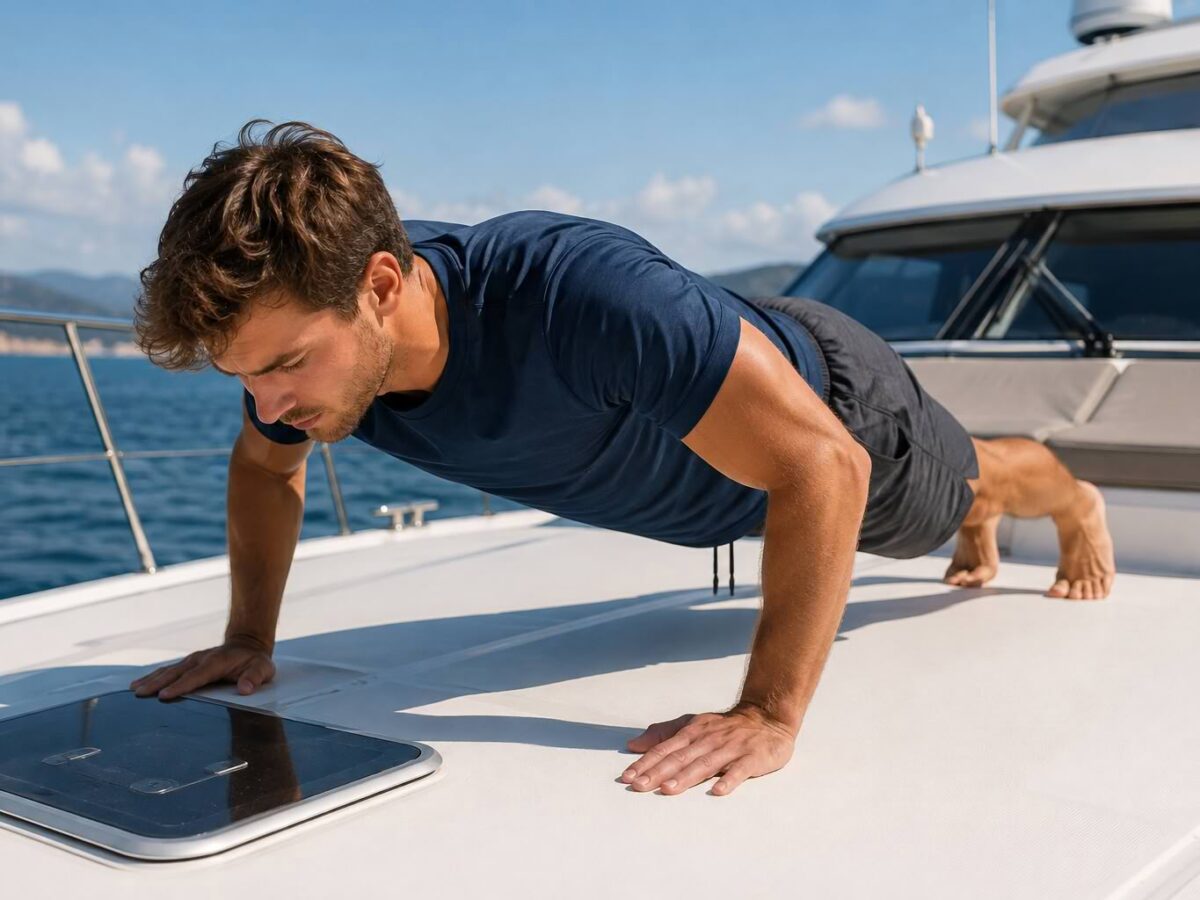
1. Push-ups
The classic – trains the chest, shoulders, triceps and the entire core. Shoulders and arms in particular benefit from the extra strength while sailing. Beginners start on their knees and/or forearms, while advanced practitioners vary their hand position (on the fists / on three fingers) or the pace. Benefit on board: more strength when trimming sheets, handling the anchor or mooring lines, or simply whenever you need to “put your back into it”.
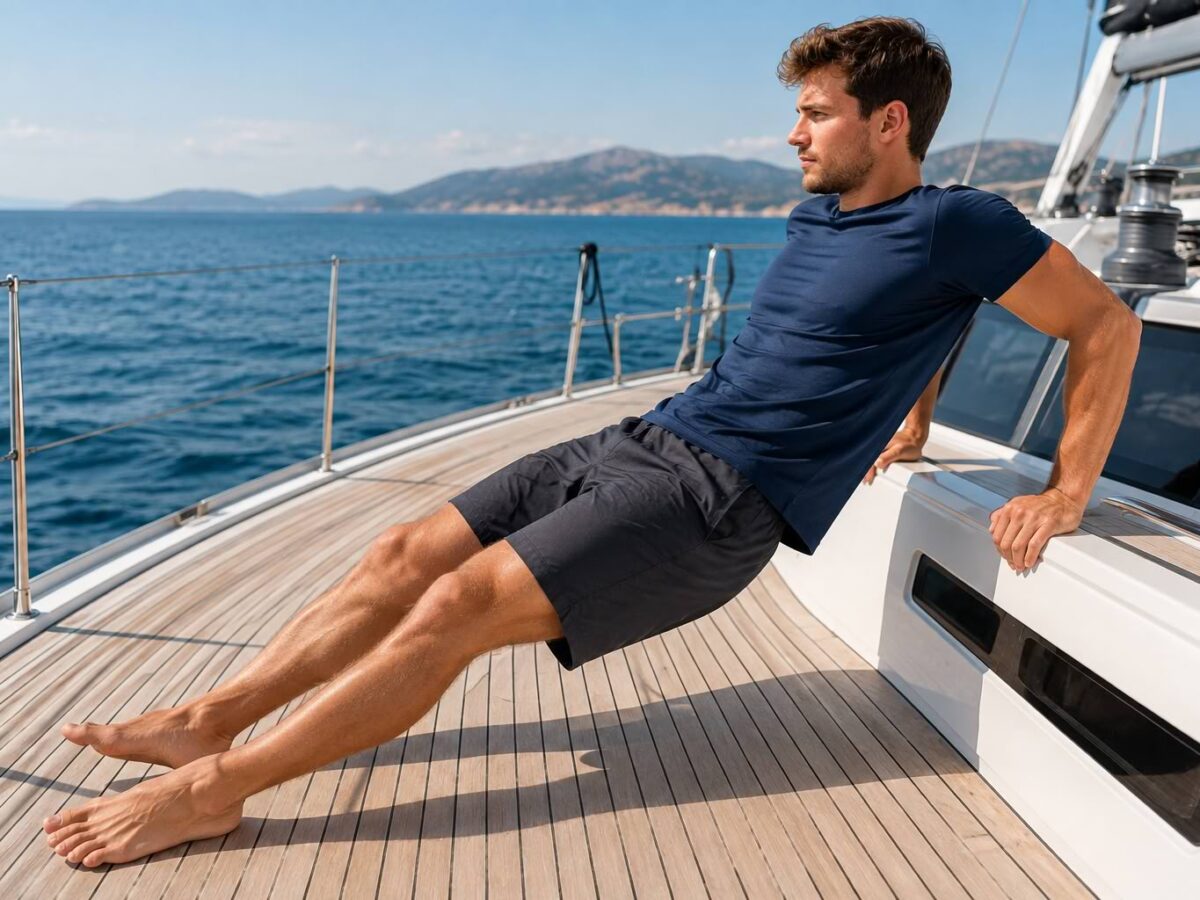
2. Reverse push-ups
The hands are placed behind the body on the cockpit bench, companionway steps, or the coachroof. This mainly works the triceps and the rear shoulders. These muscle groups are barely engaged during a classic push-up, making this a useful counterbalance.
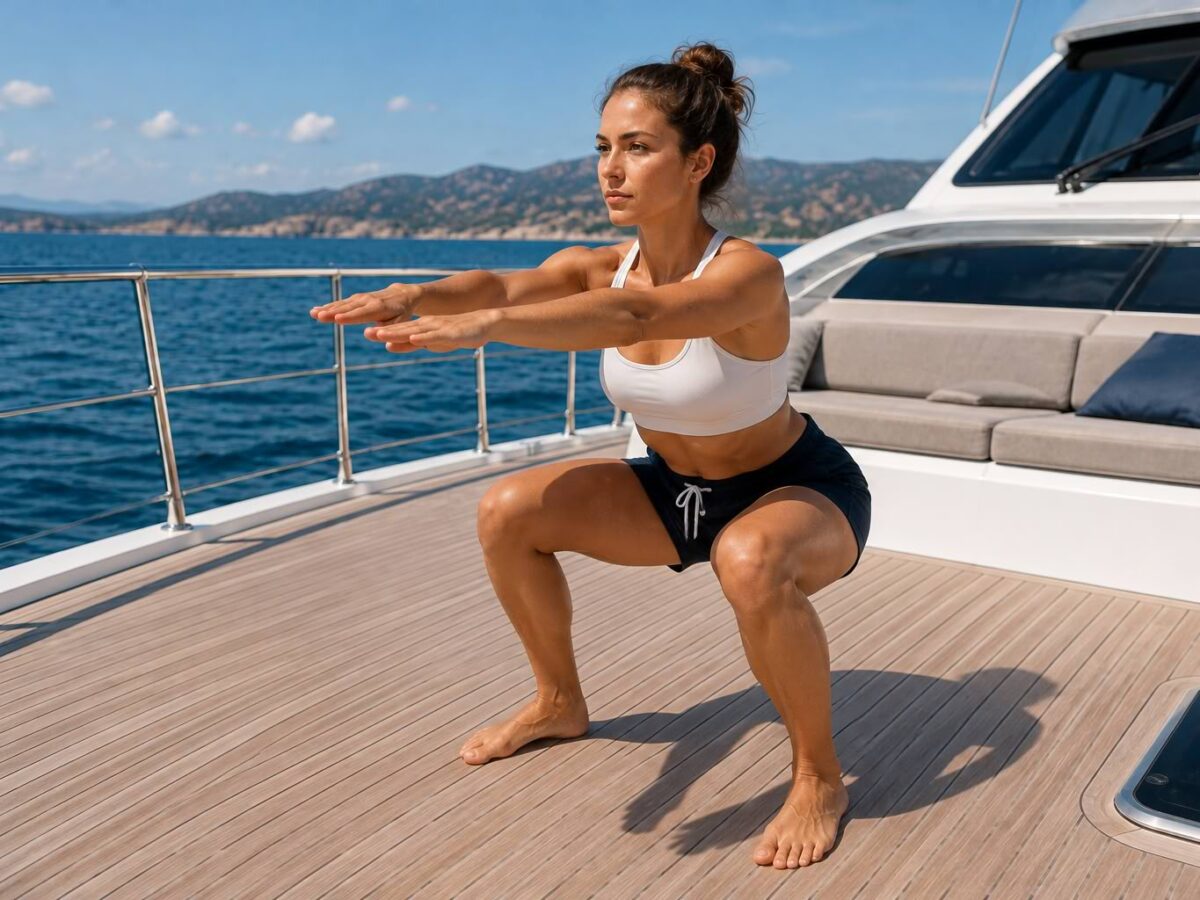
3. Squats
No other exercise works so many muscles at once. It strengthens the thighs, glutes, back, and core. With arms extended or a light additional weight, it becomes even more effective. Feet about shoulder-width apart and parallel to each other. Benefit: a more secure footing when the boat heels, and significantly more strength in the legs.
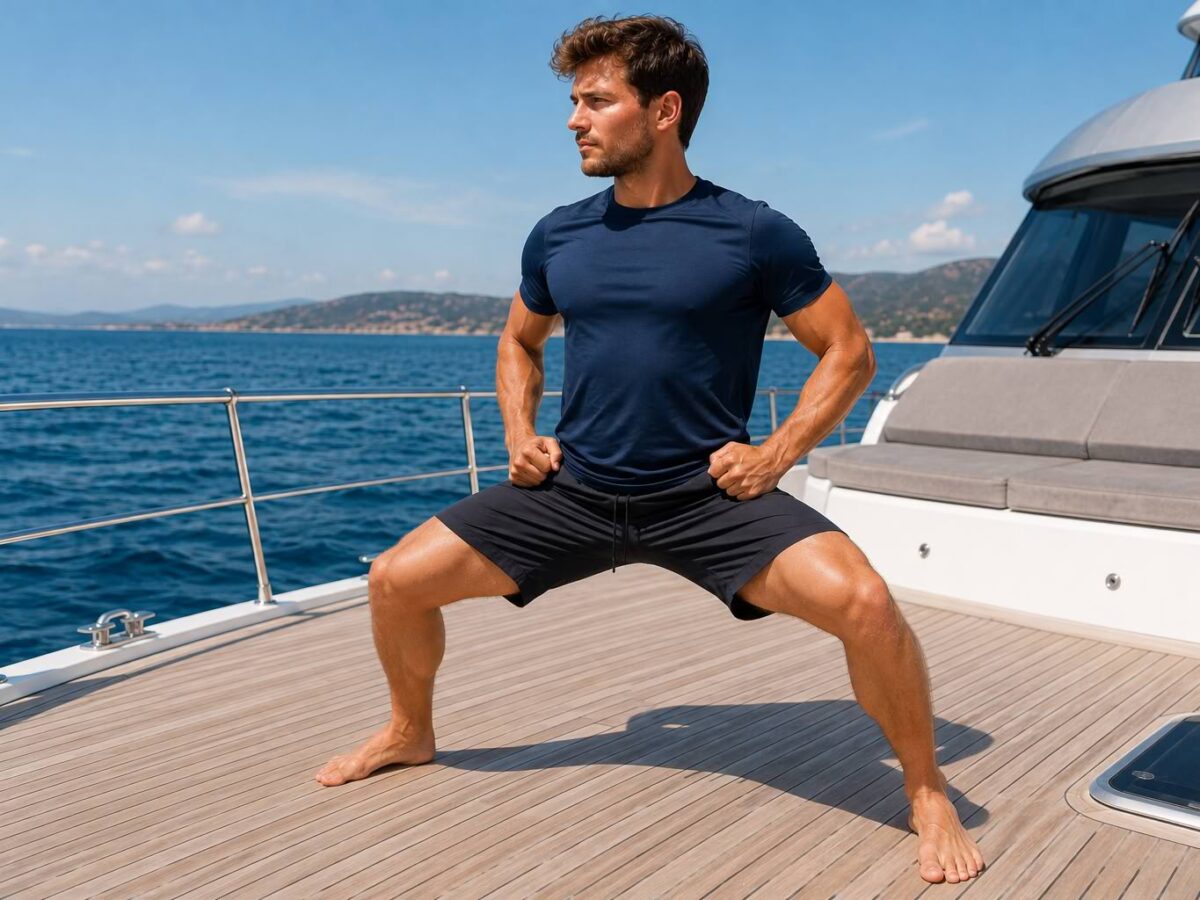
4. Horse stance – one of my favourites
The kiba-dachi (horse stance) in karate is characterised by a deep, stable stance in which the feet also point forward and parallel, but stand about twice shoulder-width apart. The weight is distributed evenly (50:50) in the centre. The stance offers excellent lateral stability, intensively strengthens the thighs (and, in karate, trains correct hip movement).
The knees are pushed outward so that the pressure lies on the thighs and the knees stay above the feet. Upper body: upright, with the pelvis tilted slightly forward (no arched lower back, glutes and abs engaged). Centre of gravity: low and exactly centred between both legs.
Benefits: lateral stability, perfect for a secure stance when the boat heels. Strengthening: intensive training for the thighs, glutes, and core muscles. Low centre of gravity: makes powerful movements (in karate: hand and blocking techniques) easier from a solid base. Try holding it for 1 to 2 minutes, or longer if you can.
Anyone who masters this stance won’t just have an easier time on board when the boat heels strongly – it’s also excellent for standing securely on jerky trains or buses – simply spread your feet slightly apart unnoticed, bend your knees a little, and you’ll stand securely without needing to hold on…
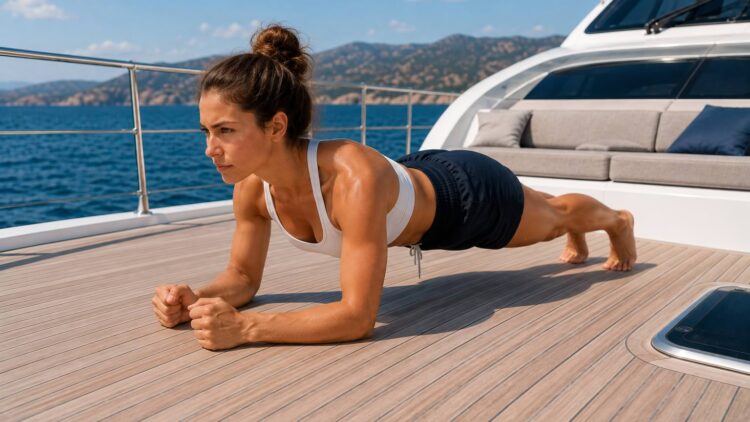
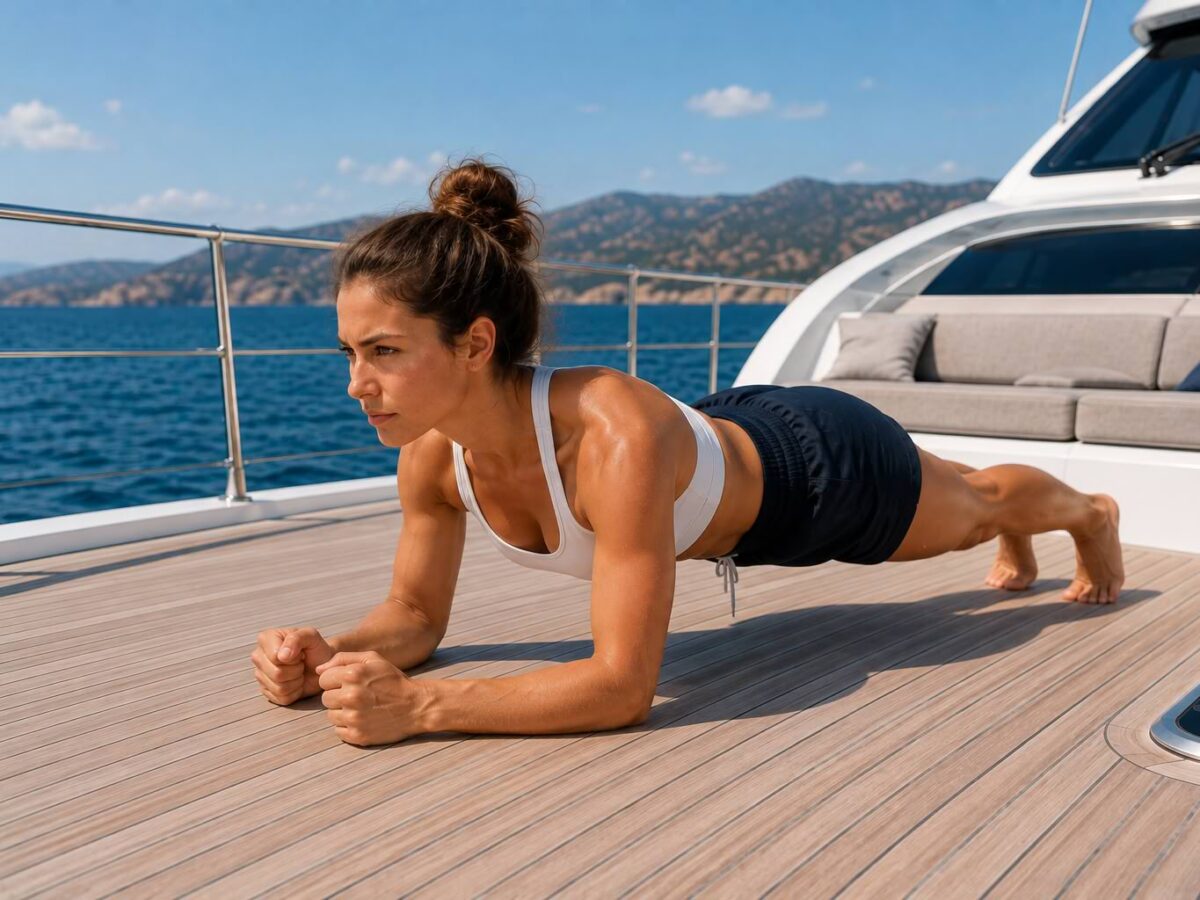
5. Plank
The forearm plank is considered one of the best exercises overall. Not everyone can or wants to do the “classic” push-up. It works almost the entire core. A stable core significantly relieves the back and spinal discs – just 30 to 60 seconds are enough.
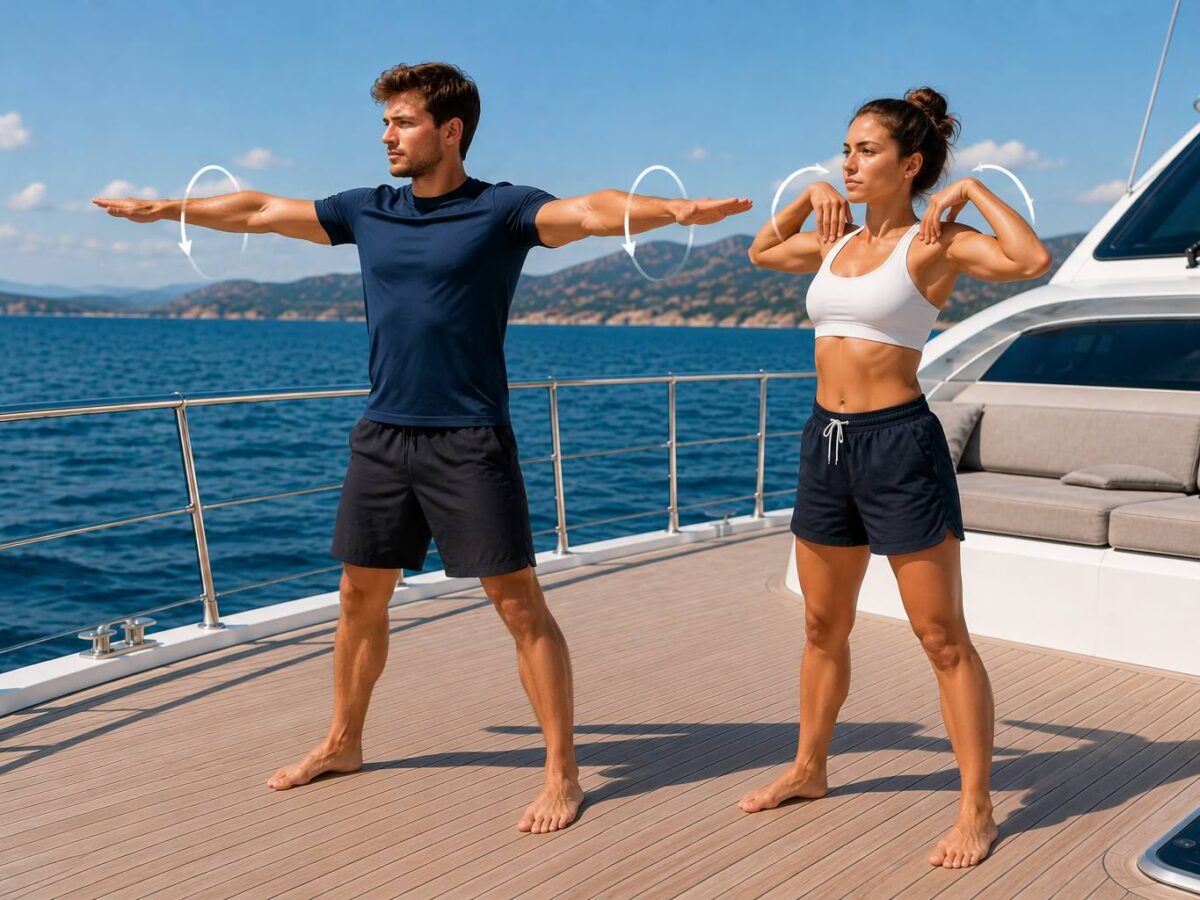
6. Arm circles and shoulder rolls
On long voyages, the neck and shoulders often become tense. Large arm circles forward and backward loosen the muscles and improve mobility. Also ideal as a stand-alone exercise in the morning or after longer watch periods.
7. Upper-body rotation
Stand upright and relaxed. Rotate the upper body to the left and right, first slowly, then more powerfully, letting the arms (relaxed) swing along loosely, first lower, then higher. This karate exercise mobilises the thoracic and lumbar spine. Particularly pleasant after long hours at the helm. Afterwards, you can combine it with gentle head circles and side tilts if you like.
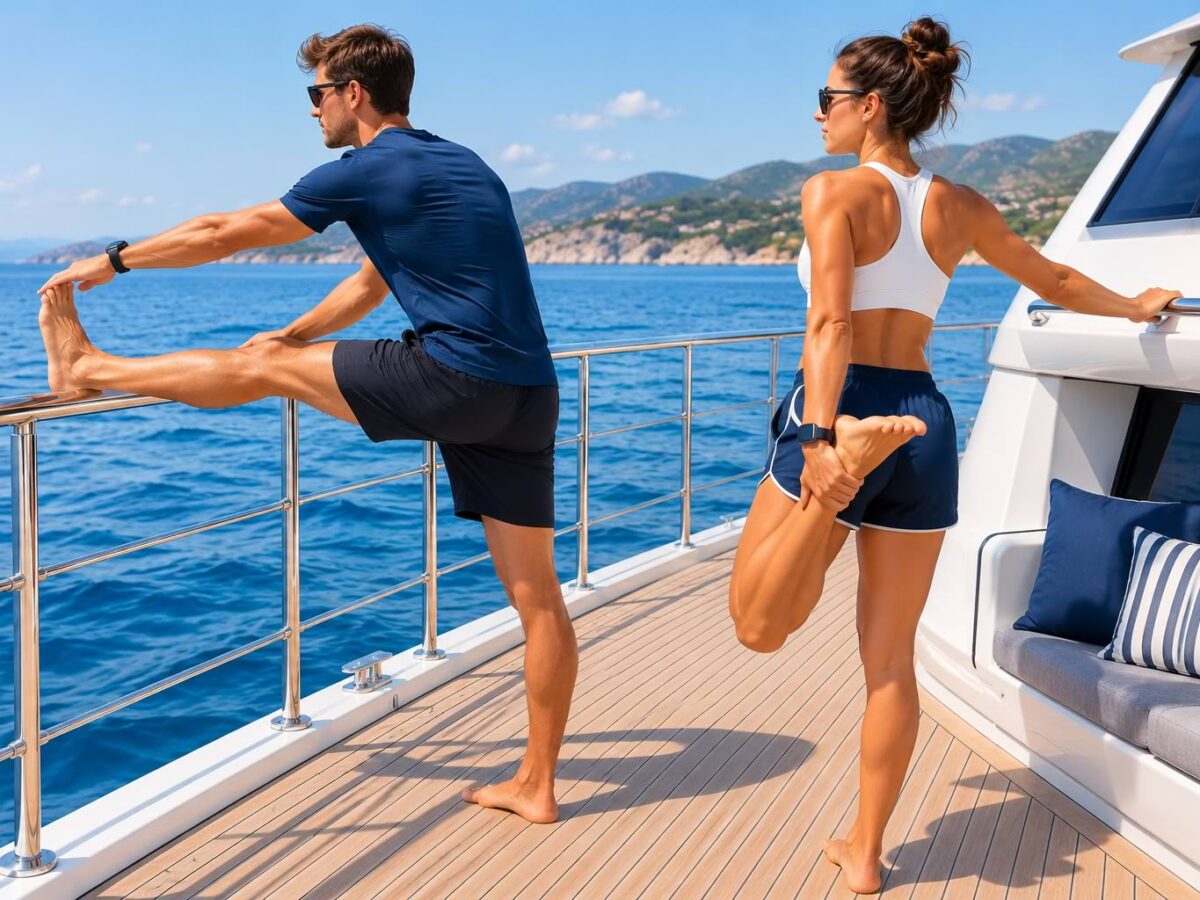
8. Stretching at the railing
The railing or shrouds are excellent for stretching. Calves, hamstrings, hips, and adductors can be loosened up almost anywhere. Hold each stretch for around 20 to 30 seconds.
9. Balance training
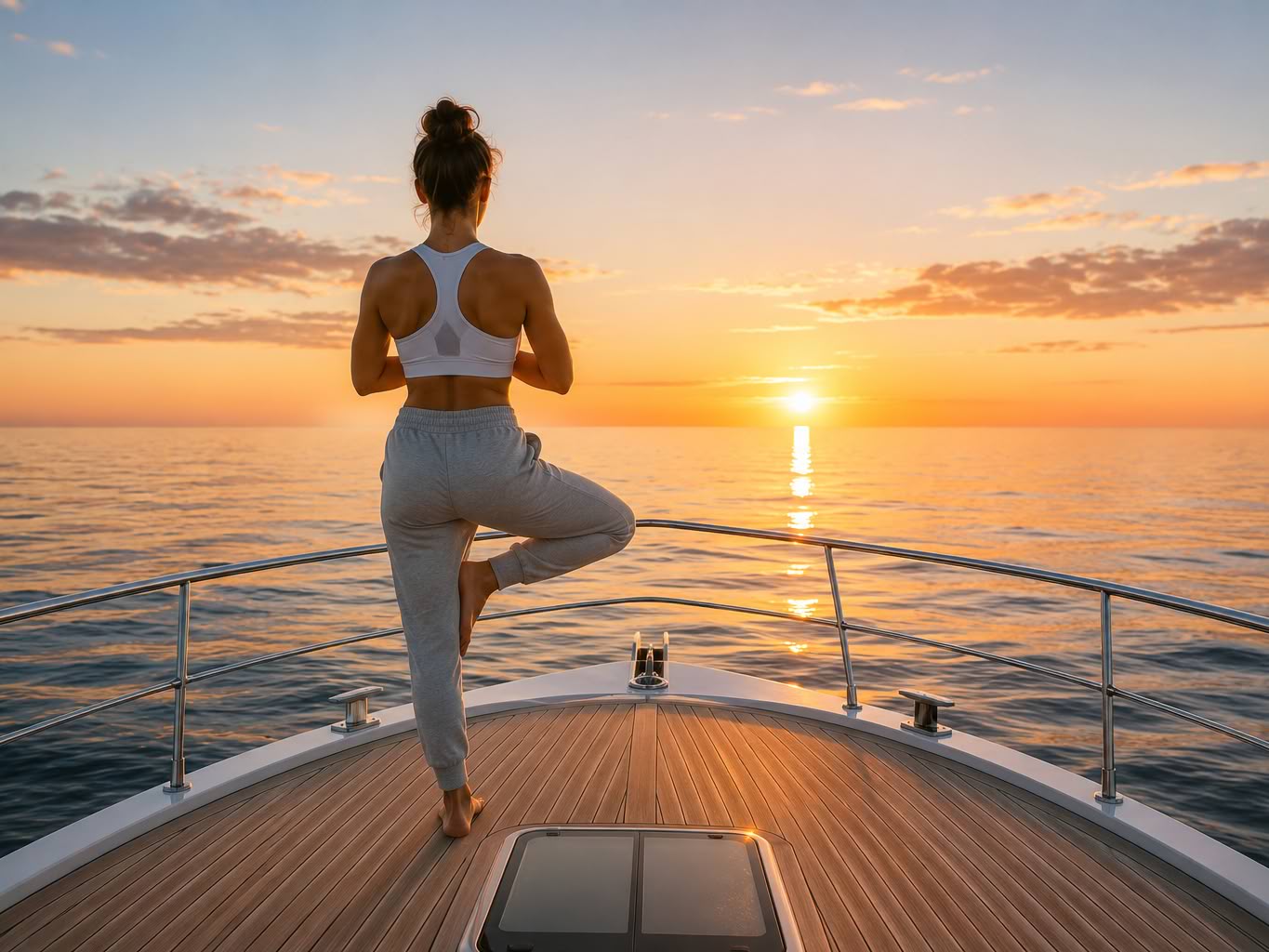
Sailors usually have good balance. Even so, it can be specifically improved. Simply stand on one leg, then later lift the other knee slightly. Advanced practitioners also close their eyes. On (slightly) rolling seas, this engages the entire deep stabilising musculature.
10. Shadow boxing or pad work
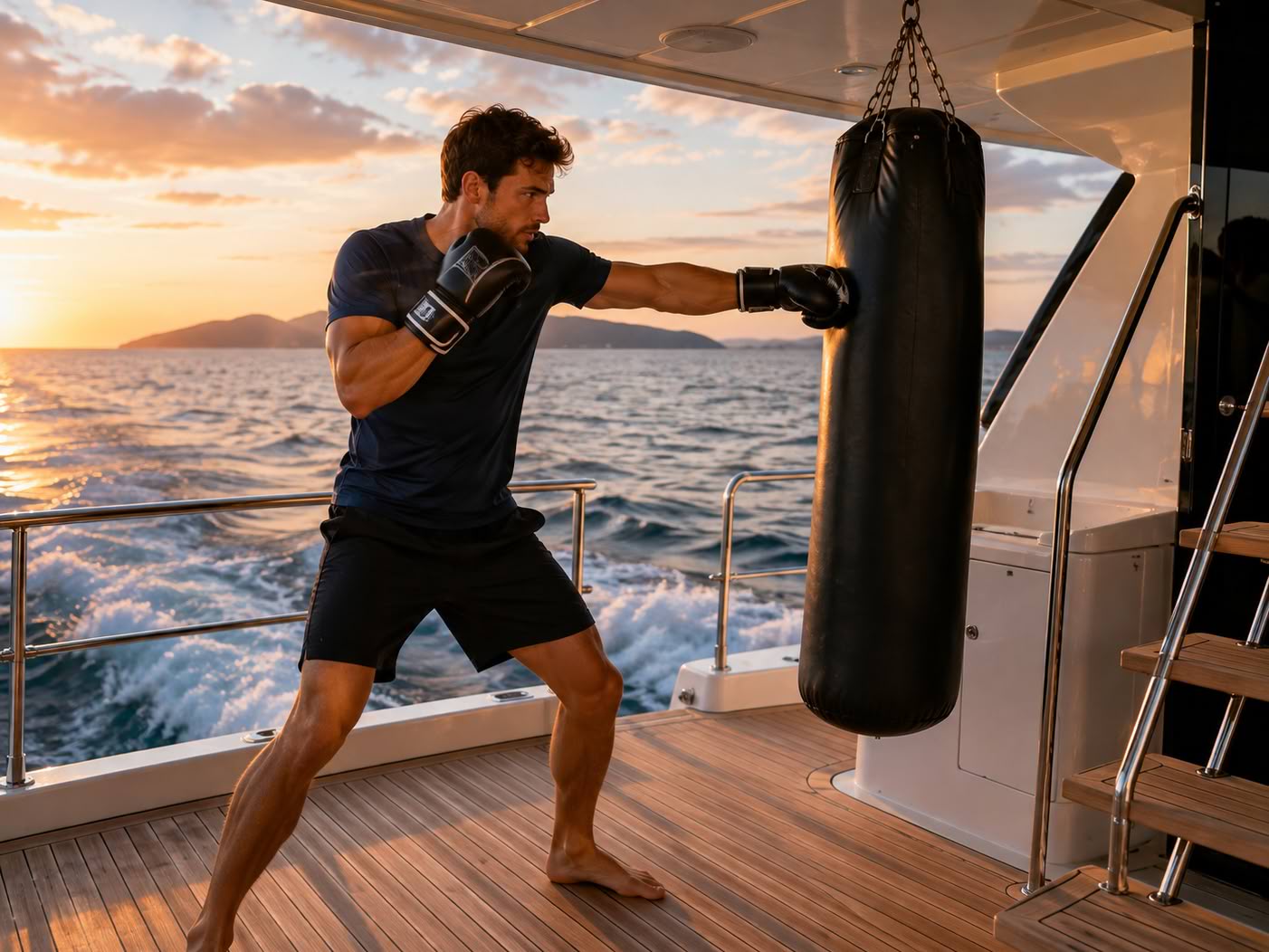
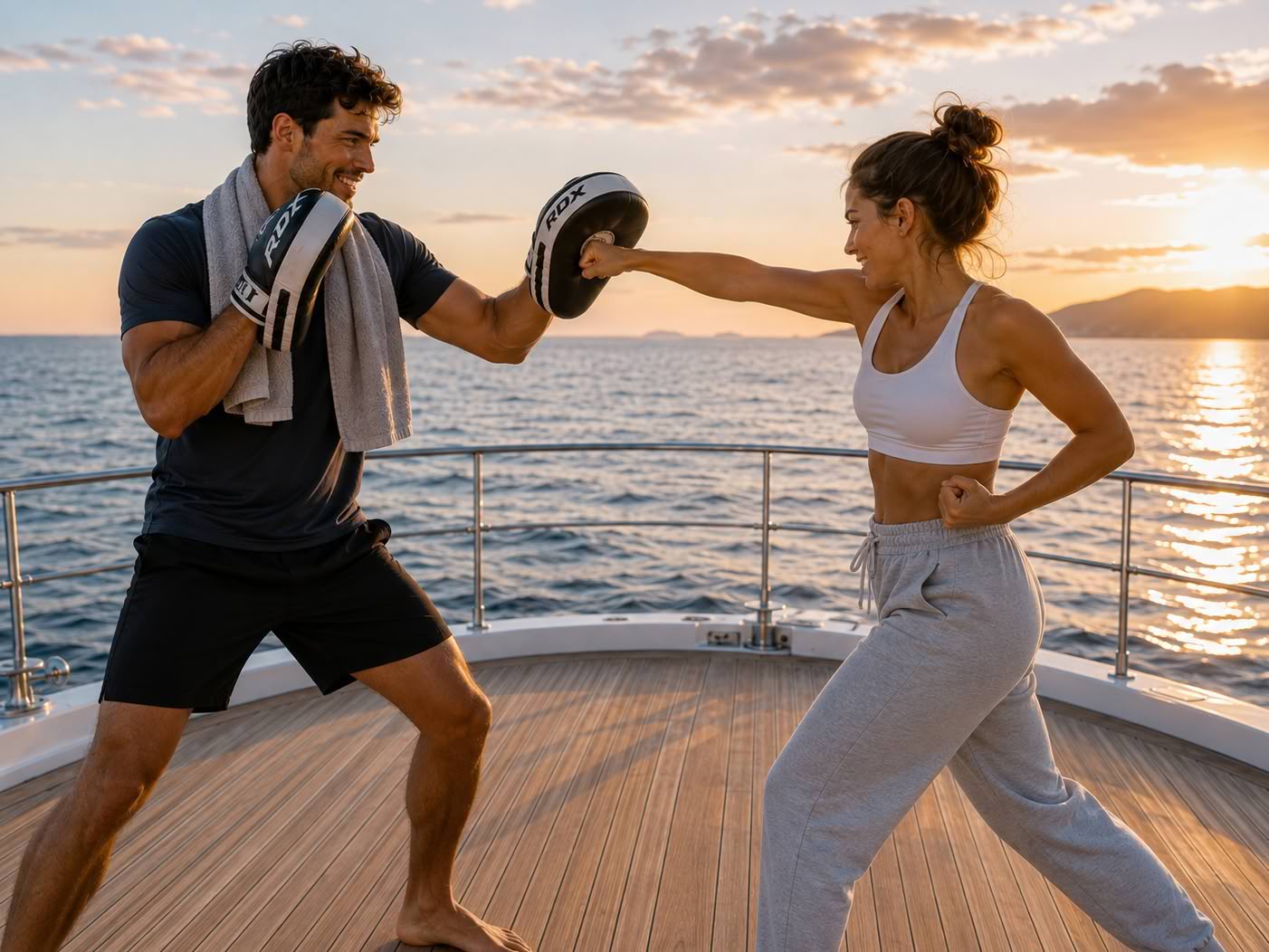
A small punching bag or a striking pad takes up surprisingly little space. Attached to the mast or boom, it’s excellent for training endurance, reaction speed, and coordination. Just three minutes of light boxing get the heart and circulation going nicely (though simple shadow boxing works too). The training also helps reduce stress on the side – sometimes worth its weight in gold after a long watch.
Dumbbell or resistance band?
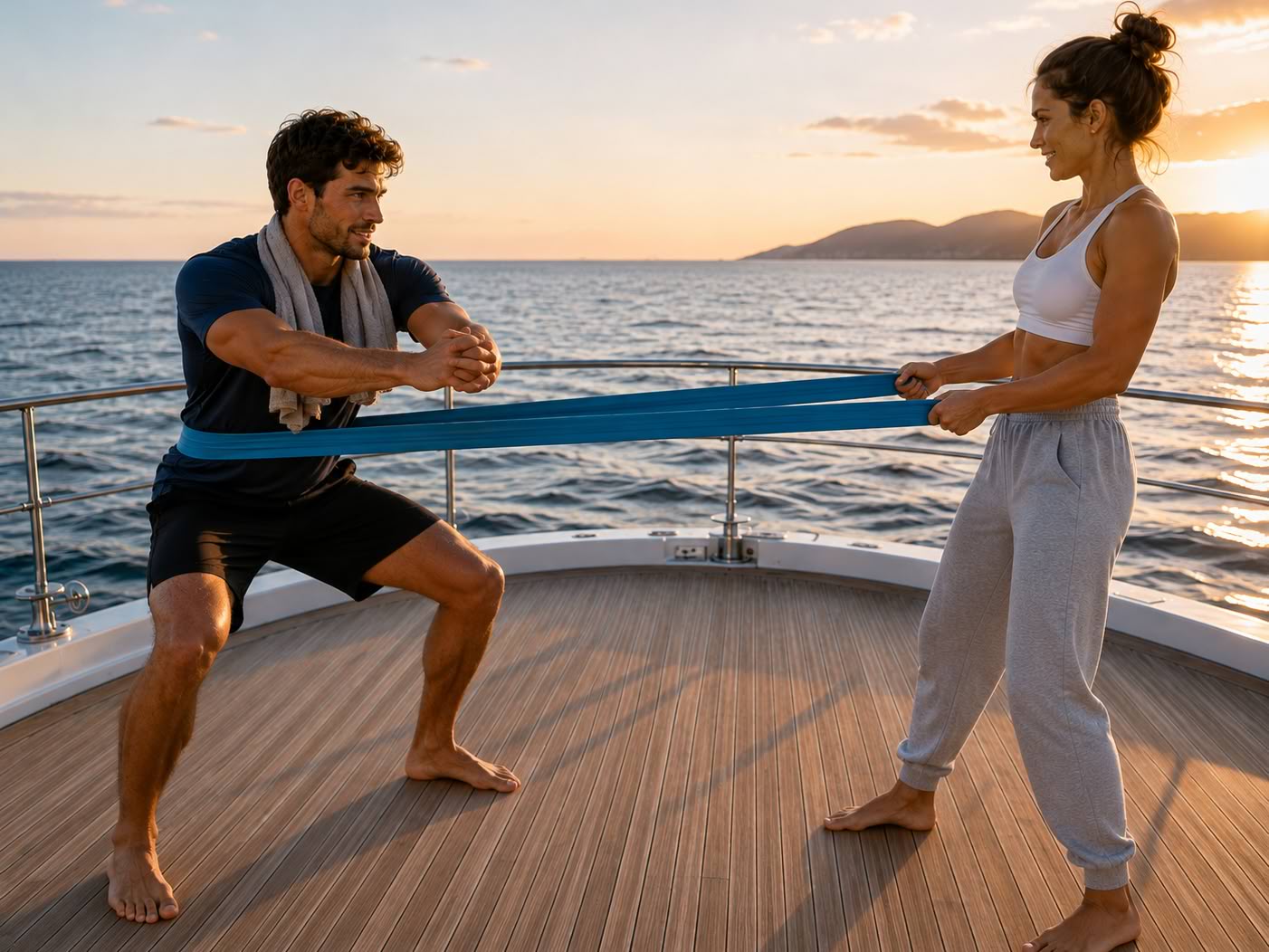
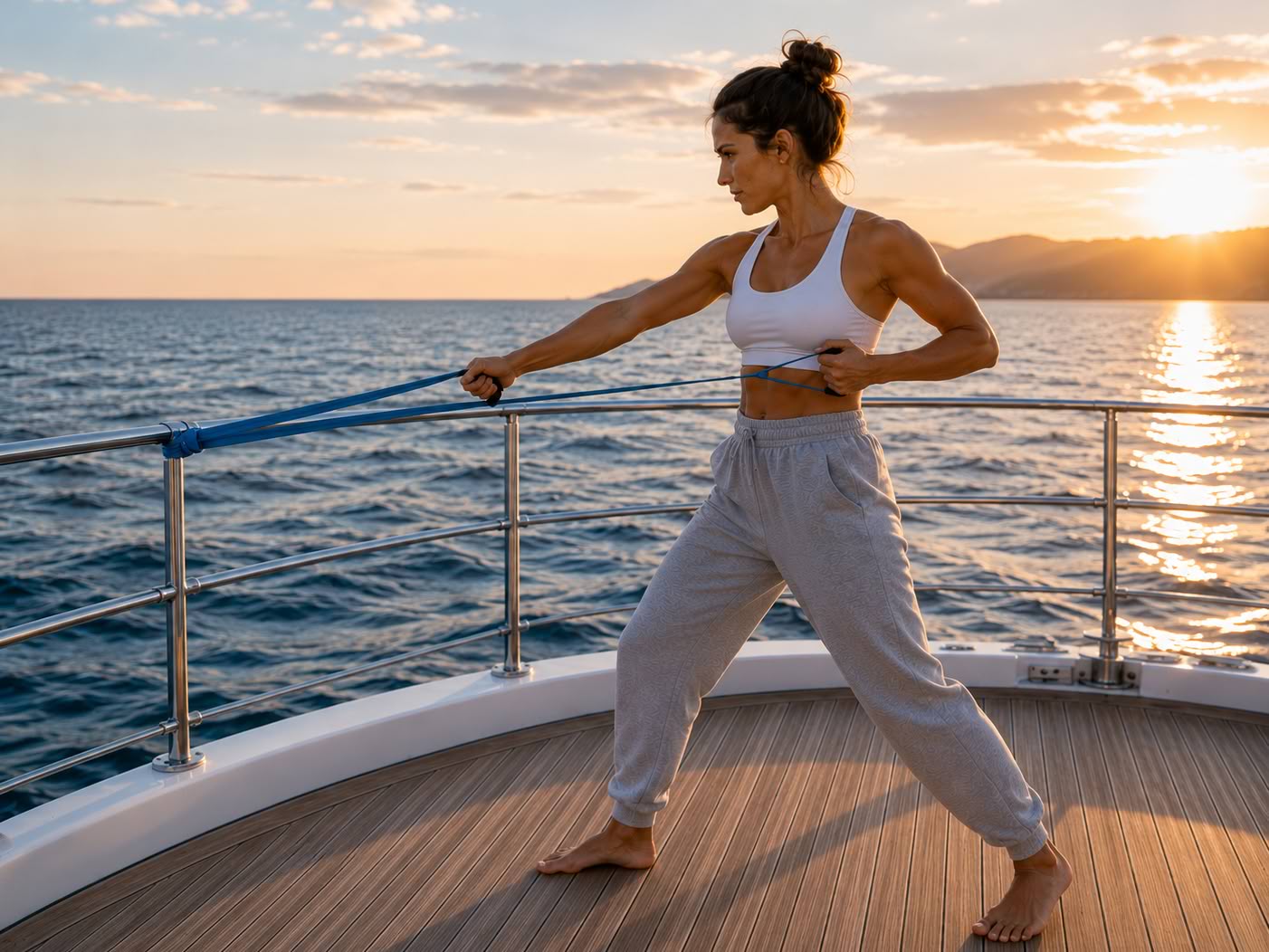
Anyone wanting to bring along a bit of equipment is better off with a resistance band than heavy weights. It weighs almost nothing and allows for dozens of exercises: rowing, shoulder training, biceps, triceps, chest, back. The band can easily be attached to the mast, railing, or a winch.
Bonus: the mobility routine
One simple insight comes from karate: strength alone is not enough. Flexibility and coordination are at least equally important. That’s why a short daily mobility routine is worthwhile: stretch the neck, loosen the shoulders, rotate the hips, mobilise the knees, move the ankles, extend the spine, and – standing with straight legs – touch your toes with your fingertips, consciously “rolling” the spine slowly up and down as you do so. Just a few minutes are enough.
The right sequence
A sensible training sequence might look something like this:
- (Warm-up) Shoulder and arm circles
- Mobilisation
- Squats
- Push-ups or plank
- Reverse push-ups
- Boxing training or resistance band
- Horse stance
- Balance exercises
- Stretching / cool down
After about 15 to 20 minutes, the programme is complete.
Nutrition matters too
Training alone is not enough. Anyone wanting to stay fit should make sure to get enough protein, fresh fruit and vegetables, and sufficient fluids (non-alcoholic and, ideally, sugar-free). Adequate sleep is just as important. Especially on long voyages, the body often recovers less well than on land. Anyone who regularly allows their body proper rest stays more focused and capable – a safety benefit that can pay off in an emergency.
On-board fitness kit (fits in a small bag):
- Theraband or resistance band
- Mini TRX suspension trainer
- Skipping rope (simple and very effective, for harbour or larger boats)
- a small folding exercise mat, if you like
- Soft boxing gloves
- Focus mitt or striking pad
- Fascia ball
- Massage ball for the soles of the feet
- Water bottle
- Small microfibre towel
Don’t forget: proper breathing
Many karateka use deep abdominal breathing quite naturally. Two to three minutes of calm inhaling and exhaling after training lowers the pulse and stress levels, aids recovery, and helps you wind down mentally after a demanding watch or a long (sailing) leg.
The same applies during the exercises themselves: breathe! And do so with the body, not against it; for example: when bending the upper body downward while standing, say to touch your toes with your fingertips – exhale; as the body straightens back up – inhale deeply. In general, the breathing flow should never be blocked (for example, don’t “strain” or hold your breath during powerful exercises).
Müncheberg: „Especially at sea, where concentration and composure are often more important than sheer muscle power, proper breathing is a factor that shouldn’t be underestimated”.
„Trained” karateka can also simply practise a few of their katas (forms) on board (slowly), and anyone who knows tai chi is also well ahead when it comes to staying fit on board.