







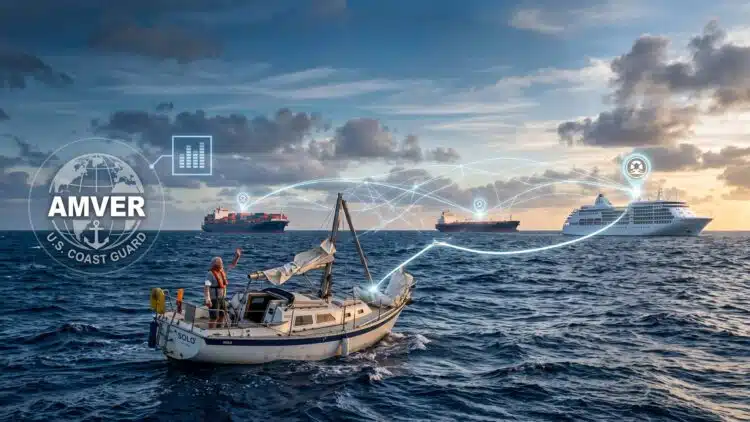
How a little-known system saved a solo sailor’s life – and why cruising sailors should know how it works.
489 nautical miles off the coast of Oregon marks the end of rescue helicopter range. When a 74-year-old solo sailor was drifting there in late May, disabled in the Pacific with a broken mast, engine failure, and a shoulder injury aboard his yacht of just nine meters, the outlook seemed grim indeed. Shortly afterwards, however, he was picked up safe and sound by a passing luxury cruise ship. This was made possible by a system that is barely known outside commercial shipping: AMVER
Contrary to a widespread assumption, however, the sailor by no means had the system “on board”. In fact, AMVER is neither an emergency transmitter nor an electronic device that needs to be installed. Rather, it is a global network of international merchant shipping – and that is precisely what makes it so interesting for cruising sailors.
The principle: finding rescuers instead of searching for the rescued
AMVER stands for Automated Mutual-Assistance Vessel Rescue System and has been operated by the U.S. Coast Guard since 1958. The voluntary system pursues a simple goal: in an emergency, the vessel that can come to a casualty’s aid the fastest should be identified as quickly as possible.
To this end, thousands of merchant vessels, tankers, freighters, cruise ships, and other ocean-going commercial vessels regularly report their planned route, their position, and any changes to their voyage to the AMVER center. This data creates a near-real-time picture of worldwide shipping. If a distress call comes in anywhere on the high seas, rescue coordination centers can determine within minutes which vessels are within range and eligible for a rescue operation.
In the case of the Canadian solo sailor, the choice fell on the cruise ship SILVER WHISPER, which altered course and finally took the man safely on board. Without AMVER, the search for a suitable rescue vessel could have taken considerably longer – time that often decides between life and death on the high seas.
The actual lifesaver
The first step towards the rescue, however, was not taken by AMVER itself, but by a satellite communication device that enabled the sailor to contact the U.S. Coast Guard. Only after his position and his distress situation were known did AMVER come into play and help identify the most suitable rescuer.
This is precisely where the system’s strength lies: it does not replace a distress call, but complements international maritime search and rescue with an intelligent network of potential rescuers.
No device, no app, no installation
Important for recreational boaters to know: AMVER can neither be bought nor installed. There is no manufacturer, no antenna, and no transmitter. The system is operated exclusively by the U.S. Coast Guard and is available to international rescue coordination centers.
The participating commercial vessels transmit their position and route data via their existing communication systems. For them, participation is voluntary and free of charge.
What does AMVER mean for recreational skippers?
Although recreational boats do not usually participate in the AMVER system themselves, they benefit directly from it in an emergency. If a yacht gets into distress in the middle of the Atlantic, the Pacific, or the Indian Ocean, rescue coordination centers can use AMVER to determine within a short time which merchant vessel or cruise ship can provide assistance.
Especially on offshore passages, ships are often the only available means of rescue. While helicopters can usually only operate a few hundred nautical miles from the coast, merchant vessels are often already in the immediate vicinity of the casualty.
For bluewater sailors, AMVER is therefore one of the invisible safety nets of the world’s oceans – even though they do not participate in it themselves.
What cruising sailors can learn from this
The recent rescue case impressively demonstrates that modern offshore safety consists of several building blocks. First and foremost, it is crucial to be able to send a distress call at all. For offshore passages, 406 MHz EPIRBs, satellite communicators, or satellite phones are therefore among the most important safety equipment on board today. Only once a rescue coordination center learns of the distress situation can it coordinate suitable rescue vessels with the help of systems such as AMVER.
For coastal waters such as the Baltic Sea, the North Sea, the Adriatic, or the western Mediterranean, however, AMVER plays a much smaller role. There, national maritime rescue services, coast guards, and rescue helicopters usually handle the operations. Or – in the case of non-life-threatening breakdowns or problems at sea – you can simply notify Europe’s largest nautical breakdown service SeaHelp via the alarm function of the free and practical SeaHelp app.
24h EMERGENCY CALL EUROPE: 0043 50 43 112
In an emergency, the SeaHelp rescue boats can be called via the practical SeaHelp app, or via the free emergency number for Europe 0043 50 43 112 (or via the alternative emergency number for Europe 00385 919 112 112.
Download SeaHelp app:


A global safety net working in the background
The spectacular rescue of the solo sailor off the American West Coast makes clear how closely modern communication and international cooperation are intertwined today. It was not AMVER alone that saved the sailor’s life – but without the global network of participating merchant vessels, the nearest suitable rescuer would probably have been found considerably later.
For recreational skippers, AMVER is therefore above all one thing: reassuring knowledge. Those who sail the oceans do not sail alone. Working in the background is a worldwide rescue network that, in an emergency, can turn a passing freighter or cruise ship into a lifesaver within a very short time.