









In June and July 2025, surface temperatures in the Mediterranean reached historically high levels. One consequence of this is an increase in thunderstorms. We have already outlined what skippers should bear in mind during a thunderstorm in our news article dated July 17, 2025. But what should you do in the event of lightning during a thunderstorm? How can you minimize the risk of being struck by lightning? And what is the best way to protect yourself and your boat?
The entire Mediterranean region recently experienced a marine heatwave, also known as a marine heatwave. This is not expected to change much in the coming weeks, with continued high air and water temperatures. The warm seas provide additional energy for thunderstorms, which means that potentially violent summer thunderstorms, heavy rain, and squalls are likely to occur more frequently, especially in coastal regions.
Boaters should therefore regularly check the weather on all available channels before setting out; if thunderstorm warnings are issued, these should be taken seriously and well-protected harbors or suitable sheltered bays should be sought in good time. We have summarized what to do in general in the event of an impending thunderstorm in our news article dated May 25, 2021.
But what should you do on a (sailing) boat if lightning strikes during a thunderstorm? How can you prevent or minimize damage in advance? And should you even stay on board during a thunderstorm?
Lightning strikes on sailing boats are rare – but extremely dangerous
Although lightning strikes on sailing boats are rare, they are extremely dangerous. With their tall masts, sailing boats are not only exposed at sea, they also act like antennas for lightning. If lightning strikes a mast, it seeks the shortest path to the ground – on a sailing boat, this is typically from the mast via the rigging into the water.
This generates very high electrical currents, which can destroy electronics, burn holes in the hull or mast, cause a fire, and endanger the people on board.
According to insurer Pantaenius, damage caused by lightning strikes is on the rise. In recent years, the number of such incidents has tripled. The relative share of the total damage amount is already around ten percent today, and the trend is rising.
You are currently viewing a placeholder content from YouTube. To access the actual content, click the button below. Please note that doing so will share data with third-party providers.
A properly installed lightning protection system is recommended
The effects of a direct or indirect lightning strike can vary greatly, but often pose a significant risk to people and property, warns the insurer. Even days after an unnoticed lightning strike, boats can suddenly sink at the dock; however, whether and how a boat survives a thunderstorm is not just a matter of luck: A properly installed lightning protection system is recommended.
Technically functional lightning protection is usually ensured by a combination of lightning conductors and surge protection. This is achieved by connecting all conductive parts on board to each other and to the ground, thus bringing them to a uniform electrical potential.
Depending on the desired protection class and the nature of the boat, one or more copper or steel lightning rods must be mounted on the masthead and other exposed parts. The energy of the lightning strike is then conducted to the ground via the lightning rod; on sailing yachts, this is done via the metal mast and the shrouds and stays.
Sailing yachts with wooden masts and motor yachts are best served by using a copper cable to divert the current to earth
Sailing yachts with wooden masts and motor yachts are best served by using a copper cable to divert the current to earth, advises Pantaenius; in any case, care must be taken to ensure that the lightning rod(s) and conductors are of sufficient size. Grounding is achieved via a steel hull, an inserted grounding plate, or the keel.
Surge protection devices would also protect downstream devices such as navigation equipment, ship lighting, and other electrical devices connected on board in the event of surges, advises the insurer. This form of lightning protection prevents damage that can occur due to inductive and capacitive surges if lightning strikes in the immediate vicinity of the yacht.
Stay on board in the cabin, well away from cables, metal parts, or the rigging
In ports, you should stay on safe jetties if possible, at a sufficient distance from the metal masts of other boats. As a general rule, do not touch the mast or metal parts under any circumstances. In particular, avoid the area around and under the mast base (if it is on deck, for example), as the discharge may be active there in case of doubt. People on board should take up a low position, if possible in the cabin, and stay well away from cables, metal parts, and the rigging.
For yachts moored in a sheltered marina or secured to a safe anchor buoy, the following applies: the boat/yacht should be disconnected from shore power, all fuses should be switched off, and all electrical appliances should be unplugged or disconnected from the on-board power supply. Furthermore, all main switches (service, engine, generator, bow thruster, anchor winch, etc.) should be switched off.
To protect against damage from lightning strikes, the yacht should be disconnected from shore power and all fuses should be switched off
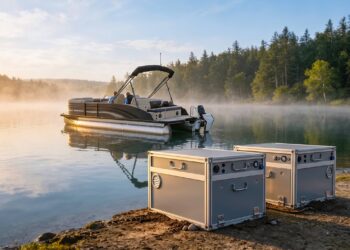
Mobile phones should be disconnected from their charging cables, handheld radios should be removed from their charging stations, and navigation devices should also be disconnected from the vehicle’s electrical system if possible. This also applies to all network cables. Compact electronic devices should be packed in a sealed metal box – if necessary, the vehicle’s oven will suffice.
This is the only way to ensure that the entire electronic system is not damaged by a lightning strike and that at least some of the electronic components can still be used after a lightning strike.
Comment from a reader (physicist): “Even if you are in a sheltered bay during a thunderstorm and lightning strikes a tree on the shore, the electrical fields of the lightning can destroy everything electronic.” In the worst case scenario, you would take refuge in a sheltered and remote bay and be there without any neighbors. If lightning then struck, there were injuries on board, and the marine radio was broken, “a working cell phone from the oven with the Sea-Help app and SOS function would be a blessing.”
Skippers who are not safely moored (this could also be the case in a marina or at an anchor buoy) should start the engine so that they can “counteract” with engine power if necessary. However, the same applies here: electrical devices that are not in use or not needed, as listed above, should be disconnected from the on-board power supply.
If lightning does strike the boat, the electrical system, electronics, and hull should be inspected thoroughly. You should also check for hairline cracks in the fiberglass hull. If necessary, a specialist company should be called in to carry out the inspection. Important: contact your insurance company immediately – many policies cover lightning strikes. Photos should be taken and submitted with the claim.