









This summer in particular, thunderstorms have required numerous rescue operations by SEA HELP employees. However, with a little know-how, dangerous situations in thunderstorms can be avoided.
Tip 1: Check the right website for thunderstorm forecasts before setting sail.
Proper storm preparation begins at home before you set sail. Before you leave, check the Croatian marine weather report meteo.hr in English at 3-day-meteograms. It shows you at a glance whether and when you can expect thunderstorms or strong winds in your area. Use Windy.com and similar sites primarily as wind forecast sites. For thunderstorm forecasts, use national weather services such as meteo.hr in Croatia or meteoam.hr in Slovenia.hr in Croatia or meteoam.it in Italy are preferable for thunderstorm forecasts.

Tip 2: What the water temperature reveals about upcoming storms.
Before setting sail, check the current water temperature on Windy.com in the Sea Temperature submenu. Everyone loves warm water, but for skippers it’s a warning sign. Elevated water temperatures can intensify storms many times over. Water temperatures around 24-25 degrees are normal on the Croatian coast in summer. If the water temperature rises to 29 degrees or above near the coast, too much energy is stored in the water, which will be released in the event of a thunderstorm or strong winds, intensifying the storm. High water temperatures do not necessarily mean that thunderstorms are imminent, but they do mean that thunderstorms will intensify into severe storms.
Conclusion: At water temperatures above 28 degrees, you should plan your trip defensively and reserve a berth in the harbor early. If thunderstorms are forecast for the afternoon, cast off early so that you can moor at your planned destination by noon.
Tip 3: Good weather periods in particular make people careless.
All sea rescue services know that prolonged periods of good weather make skippers careless. Thunderstorms can occur suddenly, and only experienced sailors can recognize stormy conditions by certain cloud formations with the naked eye.
Continue to use the 3-day forecasts from meteo.hr. As excellent as Windy or similar sites are for wind forecasts, The storm forecast is “hidden” in a special submenu in Windy. This makes it easy to overlook storms – just like in the traditional Croatian marine weather report meteo.hr. Here you can find it under the Forecasts tab, then Marine Forecast for Small Crafts. The daily weather report only covers the next 12 hours, not the next 3 days.
You are currently viewing a placeholder content from Default. To access the actual content, click the button below. Please note that doing so will share data with third-party providers.
Live thunderstorm activity on Windy – lightning density and direction in real time. (© Windyty, SE)
Tip 4: Why special websites are indispensable during thunderstorms.
The most important thing during a thunderstorm is to know the direction of the storm. So-called “rain and thunderstorm radars” use lightning to calculate the direction of the storm using a model. Sites such as blitzortung.org or lightningmaps.org do not register the calculated lightning strikes, but the actual ones. Thunderstorms always move in the direction of the foremost lightning strikes of a thunderstorm front, which can be seen on these pages. The speed at which thunderstorms move is also visible there. It can be between 10 and 100 km/h.
Thunderstorms can often be seen far to the west on these special websites the day before.
Tip 5: What are the best tactics for thunderstorms?
Thunderstorm tactic no. 1: Stay in port.
The Croatian marine weather report reliably indicates the daily thunderstorm situation from 6 a.m. onwards – albeit without precise location details or information on their intensity. When such warnings are issued, every skipper should ask themselves the following questions:
- Do I know what to do in a thunderstorm?
- Is the crew fit today? Or did we get up late last night?
- Am I fit? And can I handle it?
If in doubt, stay in port and use unclear weather conditions that do not seem manageable for a trip ashore.
Thunderstorm tactic no. 2: Head for port.
If you are looking for a berth in port when thunderstorms are likely, you will need to register two days in advance. As soon as black clouds appear in the sky and are visible to every skipper, the ports are usually fully booked.
Thunderstorm tactic no. 3: Buoys
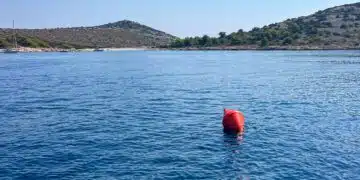
Croatia has many buoy fields. But not every buoy offers a secure hold. Buoys with heavy growth on the underside, half-submerged buoys, and buoys that are close together are signs of poor maintenance. They are unsuitable in storms.
The safest and best maintained buoys are those belonging to the harbor master’s office. The second safest are buoys belonging to marinas or private buoy operators. Harbor manuals such as the “ Buchtenfinder von Thomas Käsbohrer“ or ”888 Häfen und Buchten von Karl-Heinz Beständig” provide information about black sheep among buoy operators.
In general, you should be cautious during thunderstorms when using restaurant buoys, especially if they have small floats, and buoys at campsites. Both are usually designed for smaller motorboats and have too low a base weight. They are unsuitable for yachts longer than 8 meters.
Thunderstorm tactic 4: Anchoring.
Only those with sufficient experience should wait out a storm while anchored. The decisive factor is whether you can be 100 percent sure that the anchor will hold reliably on the seabed. It is not the type of anchor that is decisive, but the correct assessment of the holding power of the seabed and whether the anchor is really set correctly.
Clayey mud bottoms in brackish water landscapes such as lagoons or river mouths, as well as meter-thick sandy bottoms, usually offer the best hold. However, as Croatia does not have miles of sandy beaches like southern Spain or the Italian Adriatic coast, it is difficult to assess which seabeds offer good holding power. Seaweed or rocky seabeds, which are found in most of Croatia’s bays, are completely unsuitable. Important: In a thunderstorm, land lines must be released.
Thunderstorm tactic 5: Sail through the thunderstorm.
This tactic also requires experience. It is crucial to determine the direction in which the thunderstorm is moving. Skippers repeatedly report in forums that a thunderstorm “followed them for hours.” This is not correct. The skippers had simply not determined the direction in which the storm was moving and sailed unsuspectingly for hours in a thunderstorm.
If you can no longer avoid a storm:
- Start the engine. Move away from land and the coast and gain as much sea room as possible.
- Never sail into a storm.
- Roll up the sails and, above all, the furling system very tightly so that no creases form. The first gusts can tear a poorly rolled foresail to shreds in no time.
- Secure cockpit cushions, loose items, and loose bimini tops.
- Bring the dinghy and outboard motor on board. In 40-knot winds, a dinghy pulled behind the boat, including the outboard motor, will fly through the air and often land upside down in the water with the outboard motor pointing down as soon as the gust subsides.
- The safest place for the crew is below deck. Do not touch any metal parts.
- Once you have determined the direction of the wind, sail through the storm using the engine as soon as the first gusts set in. Only the engine will allow you to control the boat. The storm is often over after 15 minutes.
- Keep your distance from other boats: The greatest danger of a storm at sea is loss of visibility in heavy rain. Keep a good lookout.
Tip 6:
Nowadays, meteorologists are very good at predicting thunderstorms. However, it is more difficult to predict how severe a storm will be or whether there will be waterspouts. Whether the gusts will be 7 or 9 bft. or even stronger, how good visibility will be in heavy rain or whether hail will occur can depend on local conditions – it is the small scale that still causes problems in forecasting.
Tip 7: Safety first
Play it safe during thunderstorms. Especially with children on board, you should reserve a harbor at least two days in advance.
One thing is certain after a thunderstorm in Croatia: minutes later, the world will be beautiful again and the sun will shine as if nothing had happened.
Thomas Käsbohrer is the author of the book “Gewittersegeln” (Sailing in Thunderstorms) and regularly gives seminars on the subject. The audiobook “Gewitter im Mittelmeer” (Thunderstorms in the Mediterranean) was recently published by millemari.de.
Tip from the SeaHelp editorial team:
Further articles on the topic of thunderstorms:
TOP 5 thunderstorm myths: The truth behind common assumptions about lightning and thunder
Severe weather in Croatia: The five biggest misconceptions about thunderstorms at sea
SeaHelp-App:
If, despite all precautions, something does happen, you can request help quickly and easily with the SeaHelp app – which also provides a 3-day forecast from meteo.hr directly under the “Weather” menu item. The SeaHelp app is a must-have for every skipper’s cell phone.
Download the SeaHelp app: