









Our news article dated July 17, 2025 discussed how best to behave during a a lightning strike on a yacht and what needs to be taken into account to prevent or minimize damage caused by lightning strikes. The innovative new DDCE lightning protection system from Dinnteco International goes one step further by not “catching” the lightning and conducting it to earth, as conventional systems do, but by acting preventively to prevent or at least greatly reduce the formation of lightning in the protected area.
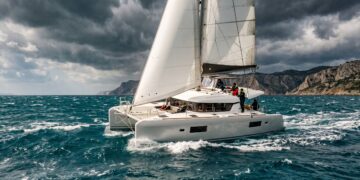
Although lightning strikes on sailing boats are rare, they are extremely dangerous. With their tall masts, sailing boats are not only exposed at sea, they also act like antennas for lightning. If lightning strikes a mast, it seeks the shortest path to the ground – on a sailing boat, this is typically from the mast via the rigging into the water.
This generates very high electrical currents, which can destroy electronics, burn holes in the hull or mast, cause a fire, and endanger the people on board. How Skippers should prepare for an impending thunderstorm and how damage can be avoided in our news article dated July 23, 2025.
The DDCE lightning protection system does not intercept lightning like conventional systems and divert it, but acts preventively
The DDCE system from Dinnteco International takes a completely different approach. This innovative, new lightning protection system does not intercept lightning and divert it to the ground like conventional systems, but acts preventively by preventing or at least greatly reducing the formation of lightning in the protected area – meaning that lightning strikes do not occur in the first place.
How does the DDCE system work? DDCE stands for Dispositivo de Descarga de Campo Electrostático, which translates as “electrostatic field discharge device.” It is a preventive lightning protection system that works on the basis of electrostatic field discharge.
It sounds complicated, but it’s actually quite simple: instead of capturing lightning like a conventional lightning rod, the DDCE ensures that the voltage between the ground and the atmosphere cannot build up to the point where lightning would occur in the first place.
You are currently viewing a placeholder content from YouTube. To access the actual content, click the button below. Please note that doing so will share data with third-party providers.
The DDCE system continuously discharges the electrostatic charge that builds up in the atmosphere
Thanks to its special design, the device continuously discharges the electrostatic charge that builds up in the atmosphere (e.g., during thunderstorms) between the sky and the ground. This minimizes the electrical potential.
Inside the DDCE, special materials and a patented structure generate micro-discharges that release ions. These lead to a uniform discharge of the surrounding area without sparking – i.e. without so-called “streamers,” which are a prerequisite for lightning formation.
The device protects a hemispherical area around itself – on yachts, this means the mast and the entire hull volume. This protective effect is roughly comparable to an energy dome. Unlike classic lightning protection systems (e.g., Franklin lightning conductors), the DDCE system does not attract lightning, but reduces the probability of it occurring in the first place.
Advantage of the system: no more discharges through the boat are necessary, eliminating the risk of secondary damage.
On boats or yachts, the DDCE system is typically mounted at the highest point, usually at the top of the mast. There it replaces the classic lightning conductor. The advantages are obvious: no more grounding is required through the boat, which also eliminates the risk of secondary damage. Electronics, navigation, and crew are protected by preventing lightning rather than by capturing and diverting it. Finally, there is no need for grounding systems in the hull, which is particularly important for fiberglass boats.
Disadvantage: the DDCE system is significantly more expensive than conventional solutions (prices range from approx. $3,000 to $5,000 for yachts). When purchasing, it is essential to ensure that the system has been tested, approved, and recognized by the respective boat insurance company. When properly installed, the DDCE system is recognized as an adequate lightning protection system by Pantaenius, for example.
It should also be noted that the DDCE system does not offer a 100% guarantee: even though the probability is greatly reduced, a lightning strike can never be completely ruled out under extreme conditions.
DDCE systems have already proven themselves in many areas, including aviation and offshore platforms.
Conclusion: The DDCE system from Dinnteco is a modern approach to active lightning prevention that is particularly suitable for yachts with sensitive electronics. It offers an innovative alternative to traditional lightning conductors and has already proven itself in many areas (including aviation and offshore platforms). For owners of high-quality sailing yachts who want maximum safety in thunderstorms, the system can be a sensible – albeit expensive – investment.
In Europe, the DDCE system is currently distributed exclusively by the Hamburg-based company ELNA, which specializes in safety and communication technology as well as electrical components for aviation, shipping, and automotive engineering.
You are currently viewing a placeholder content from YouTube. To access the actual content, click the button below. Please note that doing so will share data with third-party providers.
As with conventional lightning conductor systems, the following also applies to the DDCE system: if lightning does strike the boat, the electrical and electronic systems and the hull should be inspected thoroughly. You should also check the GRP hull for hairline cracks. If necessary, a specialist company should be commissioned to carry out the inspection. Important: the insurance company should be contacted immediately – many policies cover lightning strikes. Photos should be taken and submitted for this purpose.