








Anchoring is not a matter of chance, but rather a combination of good preparation, technical understanding, and common sense. Those who can anchor a 50-foot yacht safely and confidently will not only enjoy relaxing hours in beautiful bays, but also gain the trust of their crew—and the feeling of having truly arrived.
Anchoring is not rocket science, but good preparation and the appropriate know-how are prerequisites for a successful maneuver. In part 1 of our short “Anchoring correctly “ series, we looked at the different types of anchors available, which anchor is best suited for which purpose, whether there is such a thing as the ”perfect” anchor, and which anchor(s) you should carry on a yacht in Croatia, for example. This article is about what you should bear in mind when maneuvering an anchor.
Anchoring with a 50-foot yacht is more than just dropping an anchor – it is an art that requires technical understanding, experience, and responsibility towards the crew, the environment, and neighboring boats. Correct anchoring maneuvers are essential, especially in heavily trafficked areas such as Croatia, where the variety of anchorages is as great as the volume of traffic. Below, we provide an overview of the most important aspects of safe and reliable anchoring.
1. Preparation before anchoring
The anchoring maneuver begins long before the anchor is dropped. The skipper must first obtain an overview of the water depth and seabed conditions; the anchorage should be carefully selected with the aid of electronic nautical charts or harbor guides.

Wind direction and weather conditions should also be taken into account – checking reliable weather apps is essential to avoid unpleasant surprises caused by shifting winds or gusts. Of course, listening to the relevant traditional weather reports and wind forecasts is also a good idea.
Finally, it helps if the skipper and crew already have some knowledge of the area: in many Croatian bays, for example, seaweed lies on top of sand – which initially provides grip, but can quickly fail in a storm. The proximity to cliffs, restricted areas, or mussel farms should also be checked in advance.
2. The different types of anchorage and the correct procedure
A modern anchor (e.g., Rocna, Vulcan, Spade – see part 1 of “Anchoring Correctly”) digs into sandy or muddy ground very well. You should use several times the depth in chain; 5 times the chain length is recommended (in strong winds, use more, up to 7 times), so at a depth of 5 m, that means 25 to 35 m of chain.
Key point: seaweed and Posidonia meadows: the Anchoring in seaweed is ecologically problematic and is now even prohibited or undesirable in many areas of Croatia. In these cases, the crew should either move to sandy areas or go to designated buoy fields.
Anchor beds consisting mainly of rock and rubble offer comparatively little hold and carry the risk of getting stuck or slipping. On rocky ground, an additional stern anchor may help to keep the boat steady.
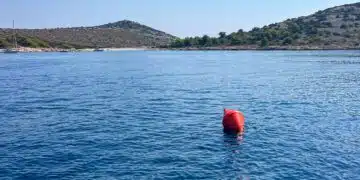
In mooring fields (e.g., in front of taverns in Croatia), the anchor is usually not needed – instead, a mooring line provides the hold. Nevertheless, you should have an anchor ready and know how to use it in case the mooring line fails.
You are currently viewing a placeholder content from YouTube. To access the actual content, click the button below. Please note that doing so will share data with third-party providers.
3. The anchoring maneuver
A good anchoring maneuver should be calm, with clear commands and a systematic approach. An example of such a maneuver could be as follows:
- Command to the crew: if necessary, communication can be via sign language or radio.
- Head for position: slowly move into the wind, then stop. SeaHelp tip: Always steer the yacht/boat directly over the spot where you want to anchor – this way, you can immediately see large stones/rocks, i.e., hazards or underwater terrain changes in clear water.
- Drop the anchor: As soon as the boat begins to drift backwards, drop the anchor. SeaHelp tip: You should be clear about whether you want to anchor only (and then swing) or also use a shore line (the length of the anchor line depends on this); rule of thumb: 5-7 times the water depth when swinging, 7-10 times the water depth with a shore line; the reaction time with a shore line is very short if the anchor slips.
- Release the chain: deploy evenly while reversing.
- Retract: shortly before the end of the chain, “retract” the anchor, i.e., reverse slowly to dig the anchor in. If you have moored with a shore line, you should align the anchor with the windlass and dig it in. On a motor yacht, idle speed is sufficient to ensure that the anchor holds even in strong winds. On a sailing yacht, the anchor should be tightened at approx. 1,000 rpm in reverse gear.
- Stop reversing: as soon as the boat stops moving (anchor holds), stop the engine.
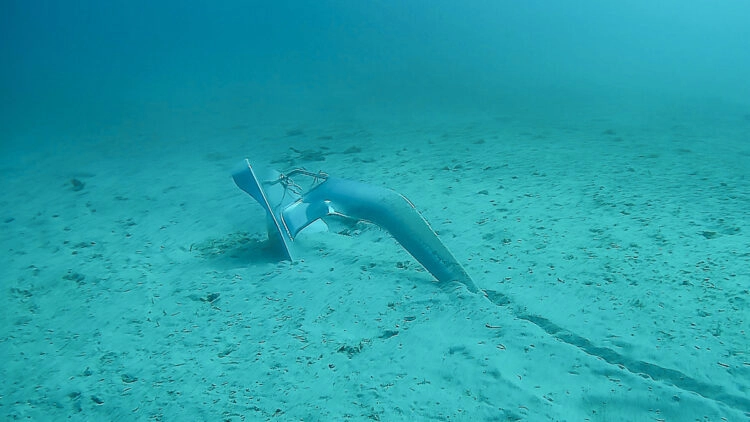
SeaHelp tip: you should always do a little “anchor test” – i.e., check the hold again by reversing a little. On the GPS or plotter, you can immediately see from the movement whether the anchor is digging in or dragging. And: once the anchor has been set and the position is right (and you want to stay longer), the skipper or an experienced crew member should always dive down to check the anchor.
When diving, make sure that the anchor chain does not form too large a loop and that the anchor has actually dug in. A positive side effect: by diving, you get to know your anchor gear, gain further experience, and can ultimately sleep more peacefully.
4. Anchor watch & control
Even before the actual maneuver, you should think about the theoretical swing circle. Once you are safely moored, this should be calculated again precisely. How large is the circle described by the boat when turning with the wind around the anchor? Sufficient space and a safe distance from other boats is essential.
Care should also be taken to avoid a leeward wall situation: you should never anchor in a bay with open water on the leeward side – if the wind picks up, there is a risk of drifting towards land or reefs if the anchor breaks loose and slides across the seabed.
Good seamanship requires checking the anchor once it has been dropped, and you should set up an anchor watch: either check the anchor manually (e.g., every 30 minutes by checking the GPS or by visual inspection – bearing to predetermined landmarks), or use one of the popular anchor watch apps. Depending on the settings, these automatically alert you in the event of drift.
5. Special information for Croatia
With regard to Croatia, it should also be noted that anchoring (which is generally free of charge) in certain areas may be subject to a fee. This applies in particular in the vicinity of existing buoy fields, in certain bays or nature parks, and when using restaurant jetties (if the restaurant is not visited).
In nature reserves and marine parks (e.g., Kornati), the following applies: Anchoring is often only permitted at certain buoys, if at all; these are usually subject to a fee (purchase of an admission ticket) – be sure to check in advance and book online if necessary. And: strong winds typical of Croatia can pick up within minutes – so always make sure you have enough chain and adequate protection when anchoring.
6. Do you need multiple anchors?
For a 50-foot yacht, a main anchor with chain (at least 10 mm) is sufficient – but: a second anchor (stern anchor or storm anchor) is useful for narrow bays, unfavorable anchorages, or emergencies and is therefore strongly recommended. Another light (folding) anchor can be carried for the dinghy.
As a general rule: the respective anchoring maneuver depends on the specific situation. In this respect, the explanations on the subject of anchoring can only be a rough guide. And: anchoring should never be underestimated. Anchoring is not a matter of chance, but a combination of good preparation, technical understanding, and common sense.
- Anchoring correctly: 10 tips for the perfect anchoring maneuver
- Anchoring – environmentally friendly and safe! Anchor freely – but correctly!
- Safe anchoring: The six biggest misconceptions about anchoring
- Correct anchoring: What every skipper should bear in mind
- SeaHelp test: Anchor buoys for moorings and anchorages