









Located directly off Playa de Palma and just a stone’s throw from Mallorca’s airport lies an exceptionally well-preserved Roman merchant ship containing hundreds of amphorae. Recovery is set to begin in March 2026 and is expected to last several months. Scientifically, the find is of immense significance, representing a “time capsule” of trade in the late Roman Mediterranean.
Can Pastilla, a district of Palma de Mallorca on the northeastern side of the Badia de Palma (Bay of Palma), northwest of the Platja de Palma beach, was previously primarily known to package tourists who frequent the area between Balnearios 9 and 15. This changed abruptly in 2019 when the wreck of a Roman merchant ship was accidentally discovered following a storm off the coast of Playa de Palma – near Can Pastilla.
The wooden wreck, estimated to be around 1,600–1,700 years old, is referred to as the “Ses Fontanelles wreck” and is considered one of the most important underwater finds of recent years in the entire western Mediterranean. The ship dates back to the 4th century AD and was approximately 12 m long and 5–6 m wide. It lies at a depth of only about 2 m and roughly 50–65 m off the coast of Playa de Palma.
The cargo of the “Ses Fontanelles wreck” includes about 300–320 amphorae containing goods such as olive oil, wine, and garum (Roman fish sauce). Of particular interest to researchers is the fact that many amphorae are still closed, sealed, and inscribed with details regarding origin, producers, or taxes. Other finds include shoes, ropes, an oil lamp featuring the goddess Diana, a coin from approximately 320 AD, and a ship carpenter’s tools. The ship likely originated from Carthago Spartaria (modern-day Cartagena) and was en route to Italy or Rome.
You are currently viewing a placeholder content from YouTube. To access the actual content, click the button below. Please note that doing so will share data with third-party providers.
Recovery operations for the historically significant shipwreck are now set to begin and will last several months
According to several reports, recovery efforts are scheduled to start in March 2026 and will continue for several months. The recovery will not be conducted “in one piece” but rather in individual segments. The reason: the ship’s keel is missing, and attempting to lift it as a whole would pose the risk of the wreck breaking apart. Following the lift, the individual parts are to be preserved in specialized desalination tanks at Fort San Carlos near Portopí.
Archaeologists describe it as an extraordinary find for several reasons, with some even calling it a “sensational discovery.” On one hand, scientists are delighted by the exceptionally good state of preservation; the ship and its cargo were buried under sand for centuries, preserving them in a virtually airtight environment. Furthermore, a complete commercial inventory was on board; hundreds of inscribed amphorae allow for a precise reconstruction of Roman trade networks. Some finds contain both Christian symbols and traditional Roman motifs, which researchers say provides a good insight into a period of religious transition.
Normally, archaeologists attempt to leave wrecks in the sea. However, in the case of the Mallorca find, a deliberate decision was made for a full recovery. There are several reasons for this. Firstly, the wreck is endangered due to its exposed location. It lies only about 2 meters deep and roughly 60 meters from the beach – practically right in the swimming zone of one of Mallorca’s most visited beaches. This creates a risk of looting, as the shallow wreck is easily accessible to amateur divers or snorkelers.
Secondly, strong waves during storms can churn up the sand and expose or destroy parts of the wreck. Additionally, there is erosion caused by coastal changes: beach nourishment and harbor construction have altered currents and could further expose the wreck, according to scientists’ concerns. For these precise reasons, they are now treating it as a so-called “rescue excavation.”
Following recovery, the wreck will be closely examined on land – a process that could take several years
The reason: as soon as parts of the wreck are exposed, they begin to decay rapidly. The ship has remained so well-preserved only because it was buried deep in the sand, which created an oxygen-poor environment – without oxygen, wood rots much more slowly, effectively becoming preserved.
Another argument for recovery: the wreck can be examined much more accurately on land; the conservation and subsequent research are expected to take years rather than months. First, the wood will be desalinated in large water tanks, followed by conservation with polyethylene glycol or sugar polymers. Only then will a 3D reconstruction of the ship’s construction take place, before the wood, amphorae, and food remains are finally analyzed in detail.
The project, named “Arqueomallornauta,” involves the Consell de Mallorca (island government, project coordination) and the National Museum of Underwater Archaeology (ARQUA), as well as several universities, including the University of the Balearic Islands, the University of Barcelona, and the University of Cádiz. The team is supplemented by an additional 30–40 specialists (divers, archaeologists, restorers, and security personnel).
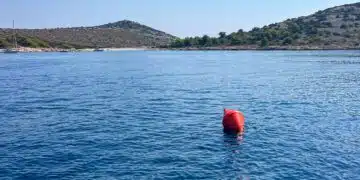
“The recovery is not expected to interfere with the upcoming water sports season,” says Robert Perger of SeaHelp Balearics; a “certain influence” is possible but, if anything, only “locally limited.” “The work could extend into the peak tourist season,” says Perger, noting that the site is located only a few meters from the beach, necessitating that the beach be cordoned off and monitored for diving and recovery operations.
However, it is only a small, clearly defined zone near Can Pastilla – “large-scale restrictions for the beach or the entire water sports zone are not currently expected.”